Gothic gematria
Gothic Gematria Calculator
Calculate any Gothic word or phrase in three methods: Standard, Ordinal and Reduced. Type Gothic letters or plain Latin letters (þ or th, ƕ or hw) to see every letter’s value.
By the My Gematria Calculator editorial team · Reviewed 2 November 2026 · Methodology
Use the Gothic gematria calculator
You can type Gothic letters or plain Latin letters. Accents and macrons are ignored, th gives þ, hw gives ƕ, and letters Gothic does not have (such as c, v and y) add no value. Everything is calculated in your browser. If the Gothic letters show as empty boxes, your device needs a font that includes the Gothic block.
More Gothic gematria tools
These tools go beyond a basic calculator. Each one runs in your browser and accepts Gothic letters or Latin letters.
1. Compare two Gothic words
Check whether two words share a value in Standard, Ordinal and Reduced at once.
2. Write your name in Gothic script
Type a name in Latin letters to see it in Gothic letters, with its Standard value. You can copy the result. This is a letter-for-letter match, not a historical translation, because Gothic has no letters for sounds such as c or v.
3. Gothic words with the same value
Enter a number, or a Gothic word, to see words in our list that share its Standard value. The list is a short, curated set of well-known words, not a dictionary.
4. Number to Gothic numeral converter
Gothic letters also worked as numbers. Enter a number from 1 to 999, or Gothic letters, to convert it. Marks used to set numerals apart in manuscripts are left out.
What is Gothic gematria?
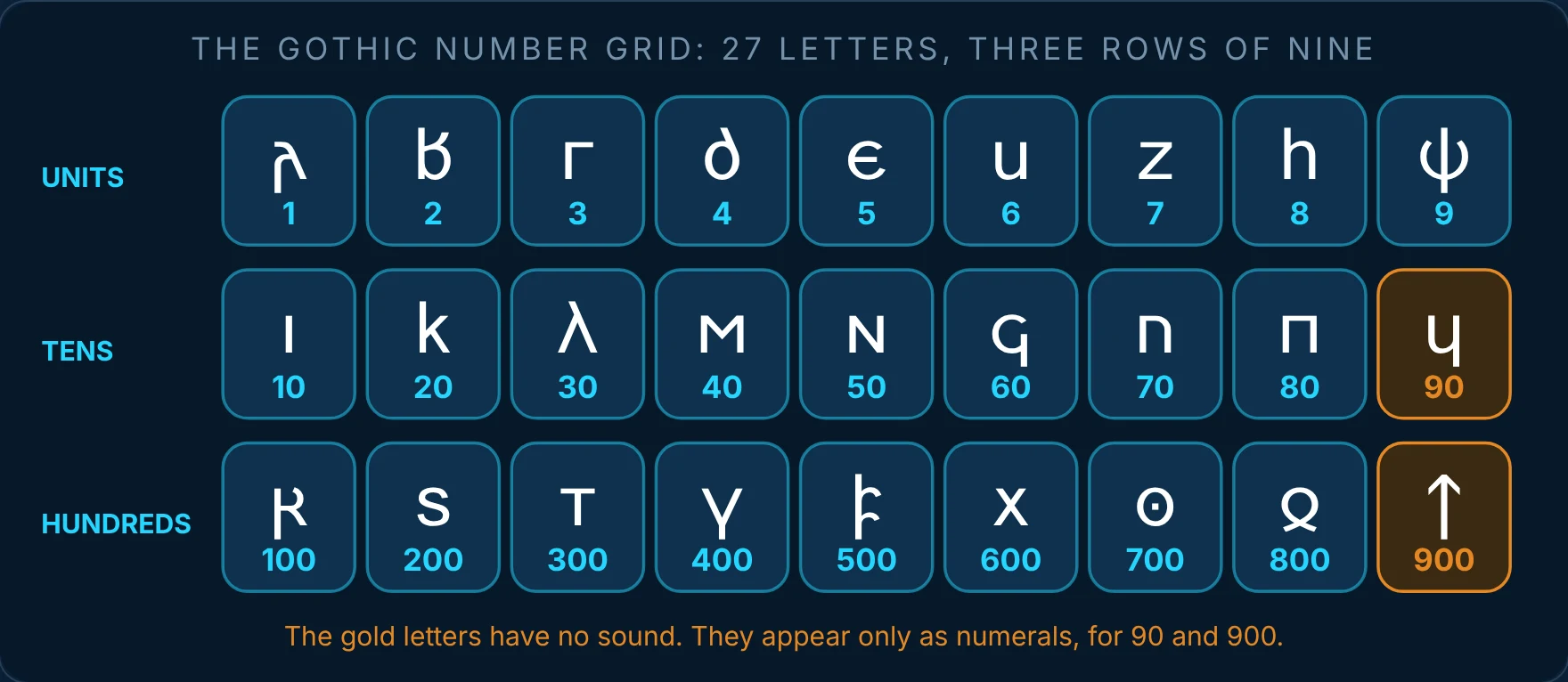
Gothic is an extinct East Germanic language. Its alphabet is traditionally credited to Wulfila (Ulfilas), the Gothic bishop who translated the Bible in the 4th century. Like the Greek alphabet it was based on, the Gothic alphabet also served as a number system, with letters standing for 1 to 9, 10 to 90 and 100 to 900.
There is no known historical tradition of Gothic gematria. This page applies the same arithmetic idea used in Hebrew gematria and Greek isopsephy: add the numeral values of a word’s letters. Standard uses the historical numeral values. Ordinal and Reduced are modern conventions borrowed from other gematria systems. For the letters and their values, see Wikipedia’s article on the Gothic alphabet.
Gothic gematria calculator methods
| Method | Rule | Example letters |
|---|---|---|
| Standard (Gothic numerals) | Letters take the historical numeral values: 𐌰 to 𐌸 are 1–9, 𐌹 to 𐍁 are 10–90, and 𐍂 to 𐍊 are 100–900. | 𐌰=1 · 𐌹=10 · 𐍂=100 · 𐍊=900 |
| Ordinal | Letters are counted by their place in the 27-letter alphabet, 1 to 27. | 𐌰=1 · 𐌹=10 · 𐍊=27 |
| Reduced | Each Standard letter value is reduced to a single digit (digit sum). | 𐌹=1 · 𐍂=1 · 𐍊=9 |
Gothic letter values
| Letter | Sound | Standard | Ordinal |
|---|---|---|---|
| 𐌰 | a | 1 | 1 |
| 𐌱 | b | 2 | 2 |
| 𐌲 | g | 3 | 3 |
| 𐌳 | d | 4 | 4 |
| 𐌴 | e | 5 | 5 |
| 𐌵 | q | 6 | 6 |
| 𐌶 | z | 7 | 7 |
| 𐌷 | h | 8 | 8 |
| 𐌸 | þ (th) | 9 | 9 |
| 𐌹 | i | 10 | 10 |
| 𐌺 | k | 20 | 11 |
| 𐌻 | l | 30 | 12 |
| 𐌼 | m | 40 | 13 |
| 𐌽 | n | 50 | 14 |
| 𐌾 | j | 60 | 15 |
| 𐌿 | u | 70 | 16 |
| 𐍀 | p | 80 | 17 |
| 𐍁 | none | 90 | 18 |
| 𐍂 | r | 100 | 19 |
| 𐍃 | s | 200 | 20 |
| 𐍄 | t | 300 | 21 |
| 𐍅 | w | 400 | 22 |
| 𐍆 | f | 500 | 23 |
| 𐍇 | x | 600 | 24 |
| 𐍈 | ƕ (hw) | 700 | 25 |
| 𐍉 | o | 800 | 26 |
| 𐍊 | none | 900 | 27 |
Gothic gematria examples
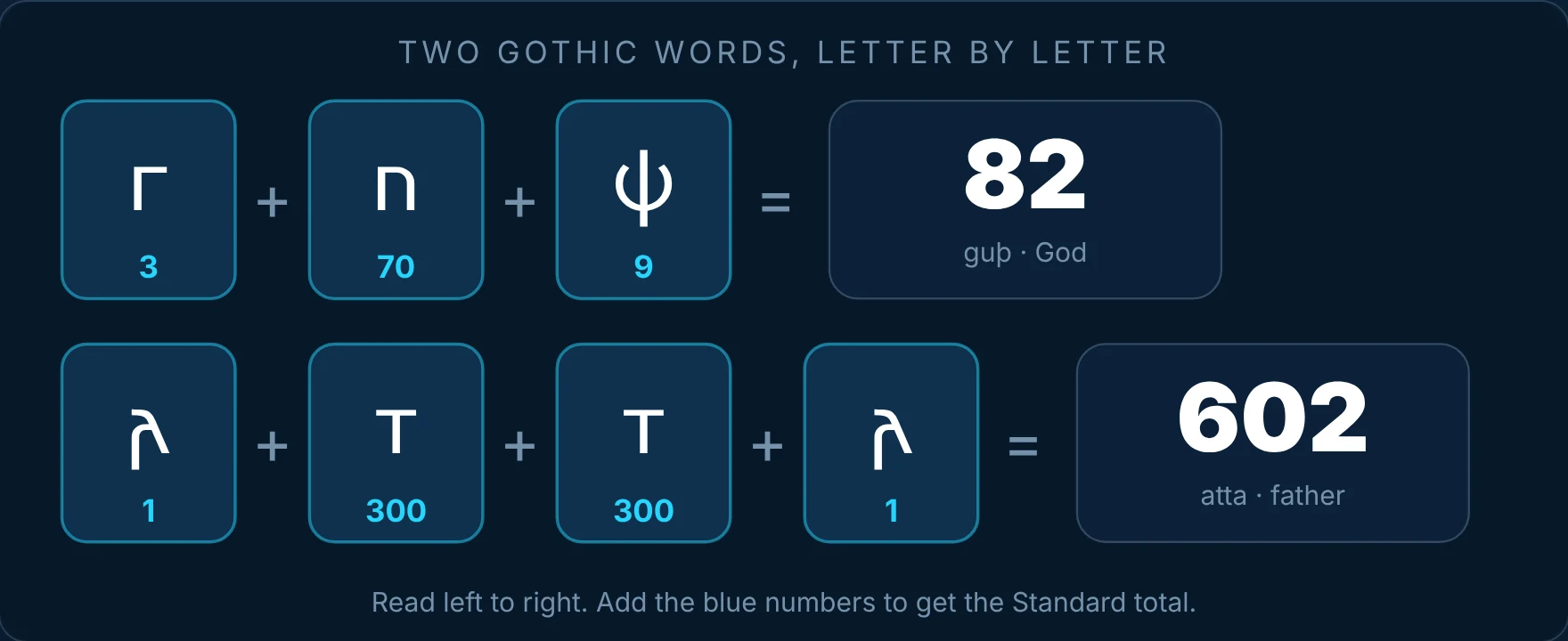
Add the letter values to check any result by hand. For example, guþ (God) is 𐌲 3 + 𐌿 70 + 𐌸 9 = 82. The words below are well-known Gothic words, written here in the usual Latin transliteration.
| Word | Meaning | Standard | Ordinal |
|---|---|---|---|
| 𐌲𐌿𐌸 (guþ) | God | 82 | 28 |
| 𐌰𐍄𐍄𐌰 (atta) | father | 602 | 44 |
| 𐌰𐌷𐌼𐌰 (ahma) | spirit | 50 | 23 |
| 𐌻𐌹𐌿𐌷𐌰𐌸 (liuhaþ) | light | 128 | 56 |
| 𐍆𐍂𐌰𐌿𐌾𐌰 (frauja) | lord, master | 732 | 75 |
| 𐌷𐌹𐌼𐌹𐌽𐍃 (himins) | heaven | 318 | 75 |
| 𐌷𐌻𐌰𐌹𐍆𐍃 (hlaifs) | bread, loaf | 749 | 74 |
| 𐍅𐌰𐌿𐍂𐌳 (waurd) | word | 575 | 62 |
| 𐌼𐌰𐌽𐌽𐌰 (manna) | man, person | 142 | 43 |
| 𐌰𐌹𐍂𐌸𐌰 (airþa) | earth | 121 | 40 |
Reading results responsibly
Equal totals show that two words add up to the same number, not that they are related in meaning. Gothic has no known gematria tradition, so treat these totals as arithmetic. Name the method with every result and compare totals only within the same method. This applies to any Gothic gematria calculator, including this one. See our editorial policy and methodology.
How to use the Gothic gematria calculator
How to use the Gothic gematria calculator: Type a Gothic word or phrase into the box at the top of the page, or tap the Gothic letter keyboard. The Gothic gematria calculator accepts Gothic letters and plain Latin letters, so guþ and guth give the same result. It then shows the Standard, Ordinal and Reduced totals and the value of every letter.
- Type or paste your word. Use th for þ and hw for ƕ. Accents and spaces are ignored.
- Read the letter breakdown. The Gothic gematria calculator lists each letter with its Standard, Ordinal and Reduced value.
- Check the three totals. Standard uses the historical Gothic numerals, Ordinal counts the letters from 1 to 27, and Reduced cuts each value down to a single digit.
- Copy or share the result. Use Copy result, Copy link or Share to keep your answer.
Why use a Gothic gematria calculator?
A Gothic gematria calculator saves you from adding letter values by hand and from looking up every letter in a table. Gothic is an extinct language known mostly from Wulfila’s 4th-century Bible translation and the manuscript called the Codex Argenteus, so few people know the letter values by heart. Our Gothic gematria calculator puts the Gothic alphabet, its numerals and the sums in one place.
What you can do with this Gothic gematria calculator
- Calculate the gematria of Gothic words and names in three methods.
- Compare two Gothic words to see whether their totals match.
- Write your name in Gothic script and find its Standard value.
- Search a short list of Gothic words that share a value, and convert numbers from 1 to 999 into Gothic numerals.
Because Gothic has no known gematria tradition, the Gothic gematria calculator is best used for study, curiosity and word play. Treat every total as arithmetic, name the method with each result, and compare totals only within the same method. The same approach works in our Hebrew gematria calculator and Greek isopsephy calculator, which use their own traditional letter values.
Whether you are learning the Gothic alphabet, checking a transliteration or exploring ancient numerals, the Gothic gematria calculator gives you a clear, checkable answer in seconds. Try guþ, atta or your own name.
Gothic gematria FAQ
How does the Gothic gematria calculator work?
The Gothic gematria calculator turns your text into Gothic letters, looks up each letter’s value, and adds the values for Standard, Ordinal and Reduced totals. It shows every letter so you can check the sum by hand.
Did the Goths use gematria?
No tradition of Gothic gematria is known. The Gothic alphabet did work as a number system, so the numeral values are real, but adding them up for words is a modern exercise based on Hebrew and Greek practice.
Who created the Gothic alphabet?
Tradition credits Wulfila (Ulfilas), a 4th-century Gothic bishop, who used it to translate the Bible into Gothic.
Why do 𐍁 and 𐍊 have no sound?
These two letters appear only as numerals, standing for 90 and 900. They fill places in the number system that the spoken alphabet did not need.
Can I type with a normal keyboard?
Yes. Type the Latin transliteration and the calculator converts it. Use th for þ and hw for ƕ. Accents and macrons are ignored.
Why do I see empty boxes instead of letters?
Your device may not have a font that includes the Gothic block. Windows, macOS and Android usually do. Updating your system or browser often fixes it.
Are Ordinal and Reduced historical?
No. Standard uses the historical numeral values. Ordinal and Reduced are modern methods borrowed from other gematria systems, included so you can compare.