Gematria Knowledge Base
English Gematria Chart A–Z: Letter Values for Four English Gematria Methods
A complete A–Z letter-value reference
Published by
/
An English Gematria chart is a reference table that shows the numerical value assigned to each letter of the English alphabet according to a specific Gematria calculation method.
Unlike a normal alphabet chart, an English Gematria chart converts letters into numbers so users can calculate the value of words, names, and phrases.
This chart includes the four English Gematria systems supported by our calculator:
- English Ordinal
- Full Reduction
- Reverse Ordinal
- Reverse Full Reduction
Each system assigns different numerical values to letters. For example, the letter M has different values depending on the selected method:
English Ordinal
13
Full Reduction
4
Reverse Ordinal
14
Reverse Full Reduction
5
The letter itself does not change. Only the calculation system changes.
Use this English Gematria chart to quickly find individual letter values before calculating a complete word or phrase.
Contents
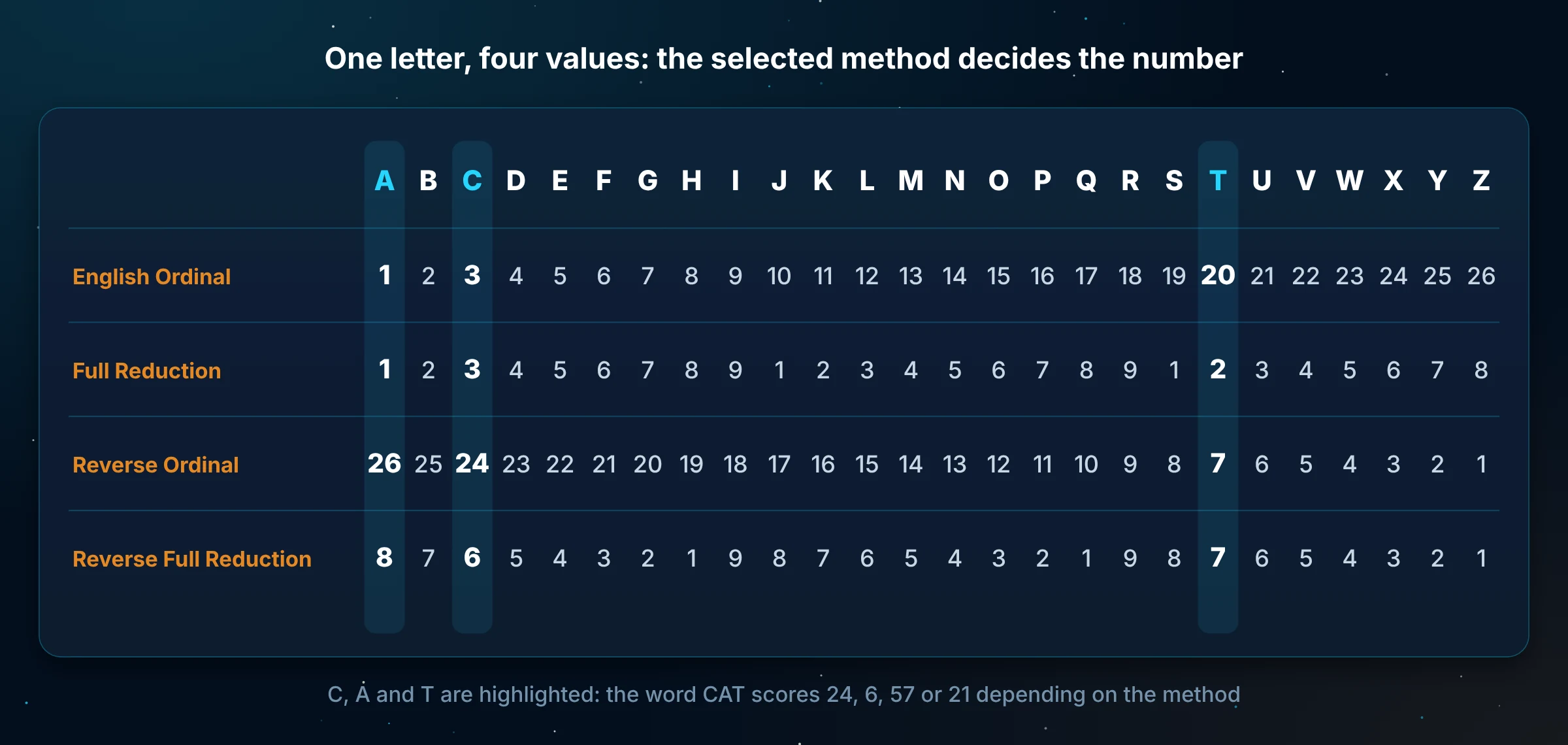
English Gematria Chart A–Z
The following table provides the complete English alphabet Gematria values for all four supported calculation methods. To put the values to work, follow the steps for using an English Gematria chart or try them on Gematria names.
| Letter | English Ordinal | Full Reduction | Reverse Ordinal | Reverse Full Reduction |
|---|---|---|---|---|
| A | 1 | 1 | 26 | 8 |
| B | 2 | 2 | 25 | 7 |
| C | 3 | 3 | 24 | 6 |
| D | 4 | 4 | 23 | 5 |
| E | 5 | 5 | 22 | 4 |
| F | 6 | 6 | 21 | 3 |
| G | 7 | 7 | 20 | 2 |
| H | 8 | 8 | 19 | 1 |
| I | 9 | 9 | 18 | 9 |
| J | 10 | 1 | 17 | 8 |
| K | 11 | 2 | 16 | 7 |
| L | 12 | 3 | 15 | 6 |
| M | 13 | 4 | 14 | 5 |
| N | 14 | 5 | 13 | 4 |
| O | 15 | 6 | 12 | 3 |
| P | 16 | 7 | 11 | 2 |
| Q | 17 | 8 | 10 | 1 |
| R | 18 | 9 | 9 | 9 |
| S | 19 | 1 | 8 | 8 |
| T | 20 | 2 | 7 | 7 |
| U | 21 | 3 | 6 | 6 |
| V | 22 | 4 | 5 | 5 |
| W | 23 | 5 | 4 | 4 |
| X | 24 | 6 | 3 | 3 |
| Y | 25 | 7 | 2 | 2 |
| Z | 26 | 8 | 1 | 1 |
English Gematria Chart Quick Comparison
Before using the chart, it is important to understand how each English Gematria method works.
| Gematria Method | Value Range | How Values Are Assigned |
|---|---|---|
| English Ordinal | 1–26 | Uses the normal position of each letter in the alphabet |
| Full Reduction | 1–9 | Reduces alphabet values into single digits |
| Reverse Ordinal | 1–26 | Uses the alphabet in reverse order |
| Reverse Full Reduction | 1–9 | Uses reverse alphabet values with single-digit reduction |
The correct column depends on the calculation method you want to use. A word can have a different Gematria value when calculated with a different system.
For background on the history of letter-number systems, see Britannica’s overview of gematria or the Wikipedia article on gematria. This English gematria chart covers only the four English methods supported by our calculator.
What Is the English Gematria Value System?
An English Gematria value system is a method of assigning numbers to letters so words and phrases can be converted into numerical values.
The English alphabet contains 26 letters, and each Gematria method applies its own rule for assigning numbers.
For example, the letter A can have these values:
| Method | Value |
|---|---|
| English Ordinal | 1 |
| Full Reduction | 1 |
| Reverse Ordinal | 26 |
| Reverse Full Reduction | 8 |
This is why it is important to identify the method whenever sharing a Gematria calculation result.
Understanding the Four English Gematria Methods
English Ordinal
English Ordinal is the simplest English Gematria system because it follows the standard alphabet order.
Each letter receives the same number as its position in the English alphabet.
Examples
A = 1
B = 2
C = 3
M = 13
Z = 26
For example:
CAT
C = 3
A = 1
T = 20
Total: 3 + 1 + 20 = 24
Using English Ordinal, CAT = 24.
Full Reduction
Full Reduction converts alphabet values into numbers from 1 to 9.
The sequence repeats after every nine letters.
Example
A = 1
B = 2
C = 3
I = 9
J = 1
K = 2
For the letter M:
M
M = 13 in English Ordinal
1 + 3 = 4
Therefore, M = 4 in Full Reduction.

Reverse Ordinal
Reverse Ordinal assigns values by counting backward through the alphabet.
Instead of A = 1, the system begins with A = 26.
The sequence continues
A = 26
B = 25
C = 24
D = 23
For example:
Example
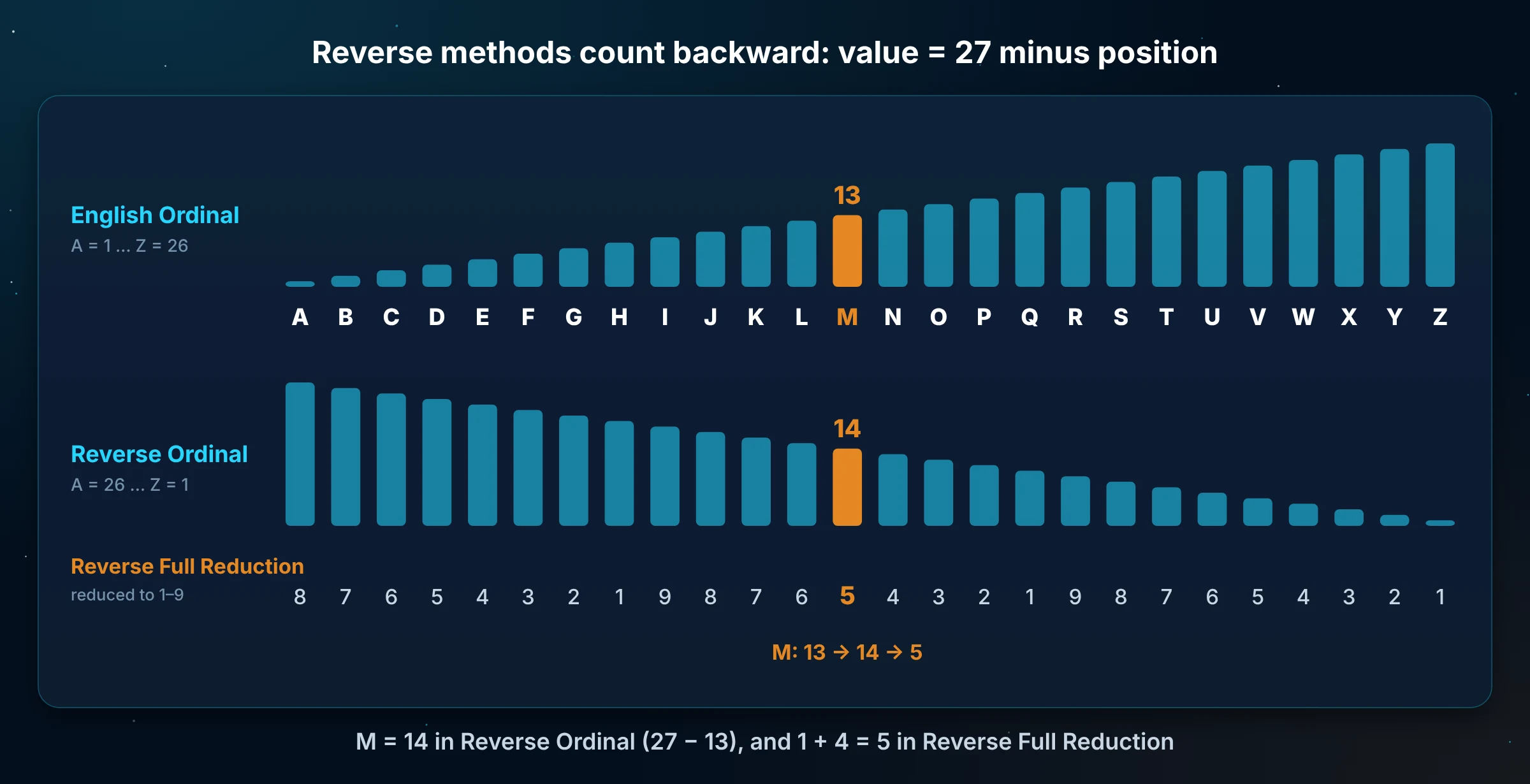
M = 14
because M is the 14th value when counted from the reverse alphabet order.
Reverse Full Reduction
Reverse Full Reduction combines reverse alphabet values with single-digit reduction.
The sequence begins
A = 8
B = 7
C = 6
D = 5
E = 4
F = 3
G = 2
H = 1
I = 9
For example:
Example
M = 5
in Reverse Full Reduction.
How to Use an English Gematria Chart
Using an English Gematria chart is simple. The main steps are:
- Choose the Gematria method you want to use.
- Find each letter in the correct chart column.
- Add the values together.
- Report the final number with the selected method.
Always use the same calculation system for every letter in the word or phrase.
For example, if you are calculating a word using English Ordinal, every letter must come from the English Ordinal column.
English Gematria Chart Example: Calculating a Word
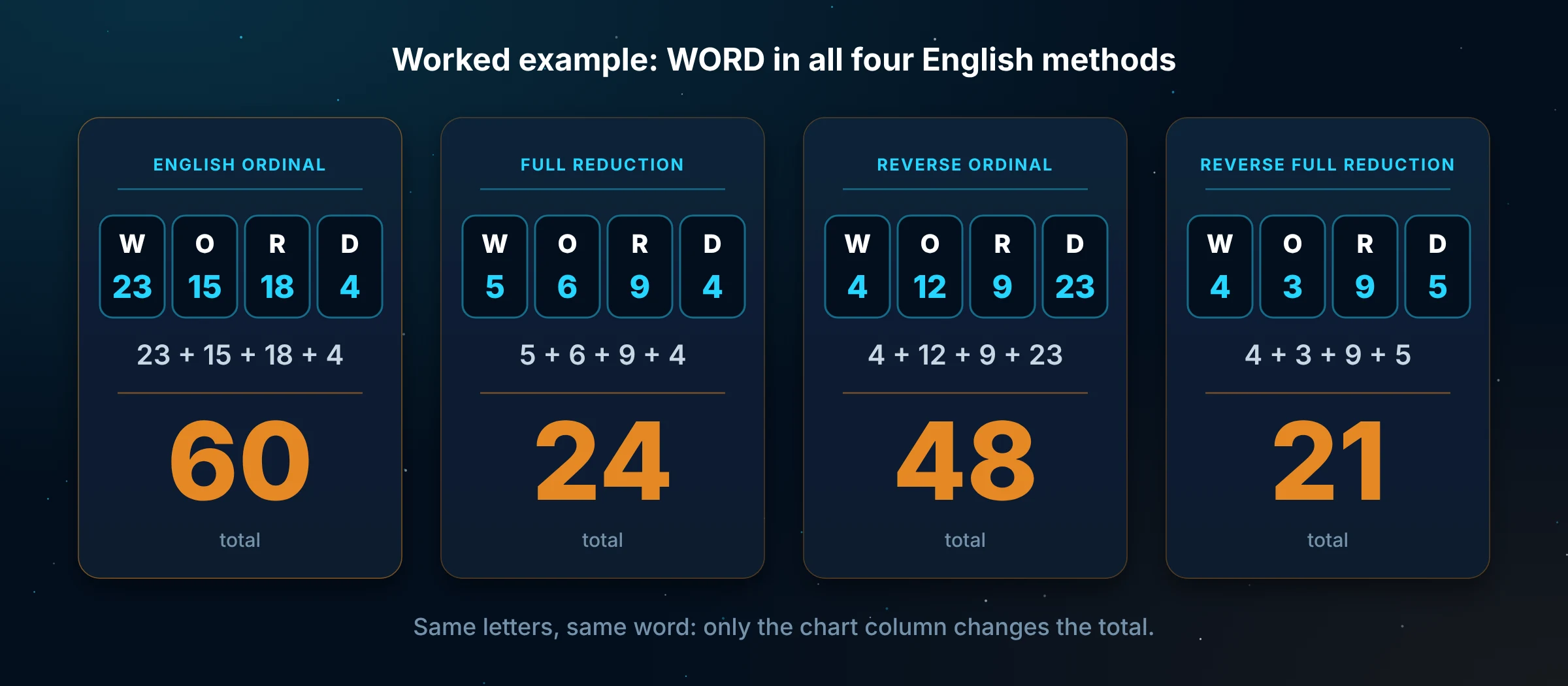
Let’s calculate the word WORD using the English Gematria chart.
English Ordinal Calculation
Using the English Ordinal column:
WORD
W = 23
O = 15
R = 18
D = 4
Add the values:
Calculation
23 + 15 + 18 + 4 = 60
Therefore: WORD = 60 in English Ordinal
Full Reduction Calculation
Using the Full Reduction column:
WORD
W = 5
O = 6
R = 9
D = 4
Add the values:
Calculation
5 + 6 + 9 + 4 = 24
Therefore: WORD = 24 in Full Reduction
The word stays the same, but the result changes because the calculation method is different.
How to Calculate a Phrase Using an English Gematria Chart
An English Gematria chart can also be used for phrases.
The process is:
Phrase → Individual letters → Letter values → Total
For example, calculate HELLO using English Ordinal:
HELLO
H = 8
E = 5
L = 12
L = 12
O = 15
Calculation
8 + 5 + 12 + 12 + 15 = 52
Therefore: HELLO = 52 in English Ordinal
Spaces are not assigned values because only letters are included in the calculation.
English Gematria Chart vs English Gematria Calculator
An English Gematria chart and an English Gematria calculator are connected, but they serve different purposes.
| English Gematria Chart | English Gematria Calculator |
|---|---|
| Shows individual letter values | Calculates complete words and phrases |
| Used as a manual reference | Performs calculations automatically |
| Helps users understand value systems | Saves time by adding values instantly |
| Useful for short calculations | Useful for longer words and phrases |
The chart helps you understand how letters are assigned numbers.
A calculator uses the same information but completes the calculation process automatically. To see how that works in practice, read our guide on how to use a Gematria calculator.
Common Mistakes When Using an English Gematria Chart
Mixing Different Gematria Methods
One of the most common mistakes is combining values from different systems.
For example, using
C from English Ordinal
A from Full Reduction
T from Reverse Ordinal
creates an inconsistent calculation.
Always select one method and use the same column from beginning to end.
Assuming Every Method Uses Alphabet Position
Alphabet position applies only to English Ordinal.
English Ordinal
M = 13
However
Full Reduction: M = 4
Reverse Ordinal: M = 14
Reverse Full Reduction: M = 5
The method determines the value.
Forgetting Repeated Letters
Every letter in a word contributes to the final calculation.
For example, in HELLO, the letter L appears twice. Both L values must be counted.
Sharing a Number Without Mentioning the Method
A Gematria result should always include the calculation system.
Clear example
CAT = 24 using English Ordinal
Less clear
CAT = 24
because another English Gematria method may produce a different result.
Frequently Asked Questions About English Gematria Charts
What is an English Gematria chart?
An English Gematria chart is a table that assigns numerical values to the letters of the English alphabet using specific Gematria calculation methods.
It allows users to look up letter values before calculating words or phrases.
What are the four English Gematria methods in this chart?
This chart includes:
- English Ordinal
- Full Reduction
- Reverse Ordinal
- Reverse Full Reduction
Each method uses a different way to assign numerical values to letters.
What is the value of A in English Gematria?
The value of A depends on the selected method:
- English Ordinal: 1
- Full Reduction: 1
- Reverse Ordinal: 26
- Reverse Full Reduction: 8
What is the value of Z in English Gematria?
The value of Z is:
- English Ordinal: 26
- Full Reduction: 8
- Reverse Ordinal: 1
- Reverse Full Reduction: 1
Why does the same letter have different Gematria values?
Different English Gematria systems use different calculation rules.
A letter does not have one universal value. The assigned number depends on the method being used.
Can I calculate English Gematria manually?
Yes. You can use the chart to find each letter’s value and then add the numbers together.
For longer words or phrases, an English Gematria Calculator can complete the process faster.
Do spaces count in English Gematria calculations?
No. Spaces and punctuation are not assigned numerical values. Only the letters included in the word or phrase are calculated.
Is English Ordinal the same as alphabet position?
Yes. English Ordinal follows the normal English alphabet order: A = 1, B = 2, C = 3, through Z = 26.
English Gematria Chart: Final Reference
An English Gematria chart provides a simple way to understand how letters are converted into numerical values.
The four systems covered in this chart are:
English Ordinal
A = 1 → Z = 26
Uses standard alphabet position.
Full Reduction
A–I = 1–9, then the sequence repeats.
Uses reduced single-digit values.
Reverse Ordinal
A = 26 → Z = 1
Uses reverse alphabet order.
Reverse Full Reduction
A = 8 → H = 1, then I = 9
Uses reverse alphabet order with reduced values from 1–9.
Use this English Gematria chart to check letter values, compare calculation methods, and understand how different systems produce different numerical results.
For automatic calculations of complete words and phrases, you can use an English Gematria Calculator to quickly apply your chosen method. New to the calculator? Start with our step-by-step guide to using a Gematria calculator.
About this guide
Written and maintained by the My Gematria Calculator editorial team. Every value is added up from the fixed English Gematria chart A–Z. Read our editorial policy and methodology. Last reviewed 31 October 2026.