Greek gematria
Greek Gematria (Isopsephy) Calculator
Use this Greek isopsephy calculator, also called a Greek gematria calculator, to calculate any Greek word or phrase in three methods: Standard isopsephy, Ordinal and Reduced. Type Greek (accents are ignored) or tap the letter keyboard to see every letter’s value.
By the My Gematria Calculator editorial team · Reviewed 31 October 2026 · Methodology
Use the Greek isopsephy calculator
Accents, breathing marks, diaeresis and iota subscripts are ignored, and final sigma (ς) counts as σ. The archaic letters stigma (ϛ), koppa (ϙ) and sampi (ϡ) count in Standard only. Everything is calculated in your browser.
More Greek gematria tools
Beyond the main calculator, these tools cover things most gematria sites leave out for Greek. Each one runs in your browser and ignores accents.
1. Compare two Greek words
Check whether two words share a value in Standard, Ordinal and Reduced at once.
2. Type Greek with a Latin keyboard
No Greek keyboard? Type in Latin letters and get Greek back, with its Standard value. Use h for η, w for ω, th for θ, ch for χ, ph for φ, ps for ψ and x for ξ. For example, agaph gives ἀγάπη without the accents.
3. Greek words with the same value
Enter a number such as 888, or a Greek word, to see words in our list that share its Standard value. The list is short and curated, so it is a starting point, not a dictionary.
4. Number to Greek numeral converter
The Greeks wrote numbers with letters (Milesian numerals), so 666 is χξϛʹ. Enter a number from 1 to 9999, or a Greek numeral, to convert it. A keraia mark (ʹ) ends a numeral, and a lower mark (͵) means thousands.
What is Greek gematria (isopsephy)?
Isopsephy is the Greek version of gematria. The word comes from the Greek isos (equal) and psephos (pebble, a counting stone), and means adding the numerical values of a word’s letters. The Greeks used their alphabet as a number system, so every Greek word had a value. A well-known example is graffiti from Pompeii that reads “I love her whose number is 545”, a name hidden in a number.
Isopsephy also matters for readers of the New Testament, where Revelation 13:18 gives a number in Greek letters, χξϛ (600 + 60 + 6 = 666), with some early manuscripts reading χιϛ (616). See Britannica’s entry on gematria and our 666 gematria page.

The three Greek methods
| Method | Rule | Example |
|---|---|---|
| Standard isopsephy | Alpha to Iota = 1–10, Kappa to Rho = 20–100, Sigma to Omega = 200–800. | α=1 · ι=10 · ρ=100 · ω=800 |
| Ordinal | Letters are counted by position in the 24-letter alphabet, 1 to 24. | α=1 · ι=9 · ω=24 |
| Reduced | Each Standard letter value is reduced to a single digit (digit sum). | ι=1 · ρ=1 · ω=8 |
Greek letter values
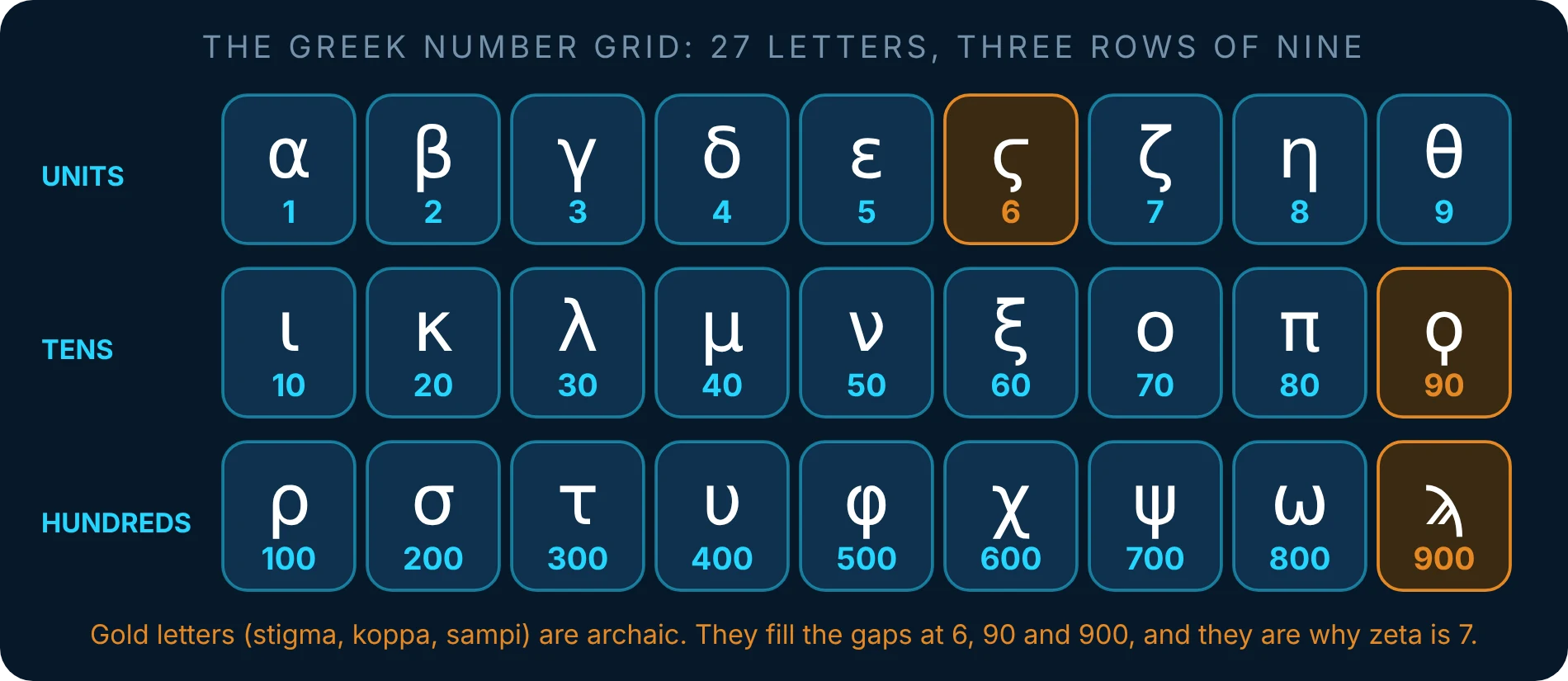
| Letter | Name | Standard | Ordinal |
|---|---|---|---|
| α | Alpha | 1 | 1 |
| β | Beta | 2 | 2 |
| γ | Gamma | 3 | 3 |
| δ | Delta | 4 | 4 |
| ε | Epsilon | 5 | 5 |
| ζ | Zeta | 7 | 6 |
| η | Eta | 8 | 7 |
| θ | Theta | 9 | 8 |
| ι | Iota | 10 | 9 |
| κ | Kappa | 20 | 10 |
| λ | Lambda | 30 | 11 |
| μ | Mu | 40 | 12 |
| ν | Nu | 50 | 13 |
| ξ | Xi | 60 | 14 |
| ο | Omicron | 70 | 15 |
| π | Pi | 80 | 16 |
| ρ | Rho | 100 | 17 |
| σ / ς | Sigma | 200 | 18 |
| τ | Tau | 300 | 19 |
| υ | Upsilon | 400 | 20 |
| φ | Phi | 500 | 21 |
| χ | Chi | 600 | 22 |
| ψ | Psi | 700 | 23 |
| ω | Omega | 800 | 24 |
| ϛ | Stigma (archaic) | 6 | not counted |
| ϙ | Koppa (archaic) | 90 | not counted |
| ϡ | Sampi (archaic) | 900 | not counted |
Greek isopsephy examples
Add the letter values to check any result. For example, ἀγάπη (agape, love) is α1 + γ3 + α1 + π80 + η8 = 93, and Ἰησοῦς (Iesous, Jesus) is ι10 + η8 + σ200 + ο70 + υ400 + ς200 = 888.
| Word | Meaning | Standard | Ordinal |
|---|---|---|---|
| Ἰησοῦς (Iesous) | Jesus | 888 | 87 |
| Χριστός (Christos) | Christ, anointed | 1480 | 118 |
| ἀγάπη (agape) | love | 93 | 28 |
| λόγος (logos) | word, reason | 373 | 62 |
| ἀλήθεια (aletheia) | truth | 64 | 42 |
| σοφία (sophia) | wisdom | 781 | 64 |
| εἰρήνη (eirene) | peace | 181 | 58 |
| θεός (theos) | God | 284 | 46 |
| χάρις (charis) | grace | 911 | 67 |
| ζωή (zoe) | life | 815 | 37 |
| ἀμήν (amen) | amen | 99 | 33 |
Reading results responsibly
Equal totals show that two words add up to the same number, not that they are related in meaning. Name the method with every result and compare totals only within the same method. See our editorial policy and methodology.
Greek gematria FAQ
What is the difference between isopsephy and gematria?
Isopsephy is the Greek form of the same idea. Gematria usually refers to the Hebrew system, but the word is also used for number-letter values in any alphabet.
Why is zeta 7 and not 6?
The Greek number system once had a sixth letter, stigma (ϛ), which dropped out of the spoken alphabet. In Standard isopsephy, zeta therefore takes 7, and stigma is used only when the archaic letter is typed.
Do accents change the value?
No. Accents, breathing marks and similar signs are not letters, so they carry no value in this calculator.
Is Greek isopsephy the same as Hebrew gematria?
No. The two alphabets have different letters and values. Compare with the Hebrew Gematria Calculator.
How to use the Greek isopsephy calculator
How to use the Greek isopsephy calculator: Type a Greek word or phrase into the box at the top of the page, or tap the Greek letter keyboard. The Greek isopsephy calculator ignores accents and breathing marks, so ἀγάπη and αγαπη give the same result. It then shows the Standard, Ordinal and Reduced totals and the value of every letter.
- Type or paste your word. You can also type Latin letters and use the Latin-to-Greek converter in the tools section.
- Read the letter breakdown. The Greek isopsephy calculator lists each letter with its Standard, Ordinal and Reduced value.
- Check the three totals. Standard uses the Greek numerals, including the old letters stigma, koppa and sampi. Ordinal counts the 24 letters from 1 to 24, and Reduced cuts each value down to a single digit.
- Copy or share the result. Use Copy result, Copy link or Share to keep your answer.
Why use a Greek isopsephy calculator?
A Greek isopsephy calculator saves you from adding letter values by hand and from looking up every letter in a table. Greek letters were used as numbers in the ancient world, so every Greek word has a natural total. Our Greek isopsephy calculator shows each step so you can check the arithmetic yourself. For example, ἀγάπη (agape, love) is 1 + 3 + 1 + 80 + 8 = 93 in Standard isopsephy.
What you can do with this Greek isopsephy calculator
- Calculate the isopsephy of Greek words and names in three methods.
- Compare two Greek words to see whether their totals match.
- Type Greek with Latin letters and let the converter write the Greek for you.
- Find Greek words that share a value, and convert numbers into Greek numerals.
Isopsephy is the Greek counterpart of Hebrew gematria, so many people also call a Greek isopsephy calculator a Greek gematria calculator. The Greek isopsephy calculator is best used for study, curiosity and word play. Treat every total as arithmetic, name the method with each result, and compare totals only within the same method. The same approach works in our Hebrew gematria calculator, Gothic gematria calculator and Arabic Abjad calculator, which use their own letter values.
Whether you are reading the Greek New Testament, checking a transliteration or exploring ancient numerals, the Greek isopsephy calculator gives you a clear, checkable answer in seconds. Try ἀγάπη, λόγος or your own name.