Gematria Knowledge Base
What Is Gematria? Definition, Meaning, Origins and How It Works
A beginner-friendly guide to the letter-to-number system
Published by
/
What is gematria? Gematria is a system that assigns numerical values to letters and uses those values to calculate words, names, phrases, or texts.
In simple terms, the answer to what is gematria is that it creates a connection between letters and numbers through a defined numerical system called a cipher.
For example, in English Ordinal Gematria, each letter is assigned a value based on its position in the English alphabet: A = 1, B = 2, C = 3, D = 4, and so on through Z = 26. A word can then be converted into a numerical value by adding the values of its letters. Example:
CAT
C = 3
A = 1
T = 20
Calculation
3 + 1 + 20 = 24
CAT = 24 using English Ordinal
The number 24 is the gematria value produced by that specific calculation method. The result depends on the Gematria system being used. Different systems can assign different numerical values to the same letters, which means the same word can produce different results.
You can try this yourself in the English Gematria Calculator. After this guide, continue with how to use a Gematria calculator, the English Gematria Chart A–Z or gematria vs numerology.
Contents
For background on what is gematria in its traditional form, see the Britannica entry on gematria and the Wikipedia article on gematria, plus the Wikipedia article on Greek isopsephy.
What Does Gematria Mean?
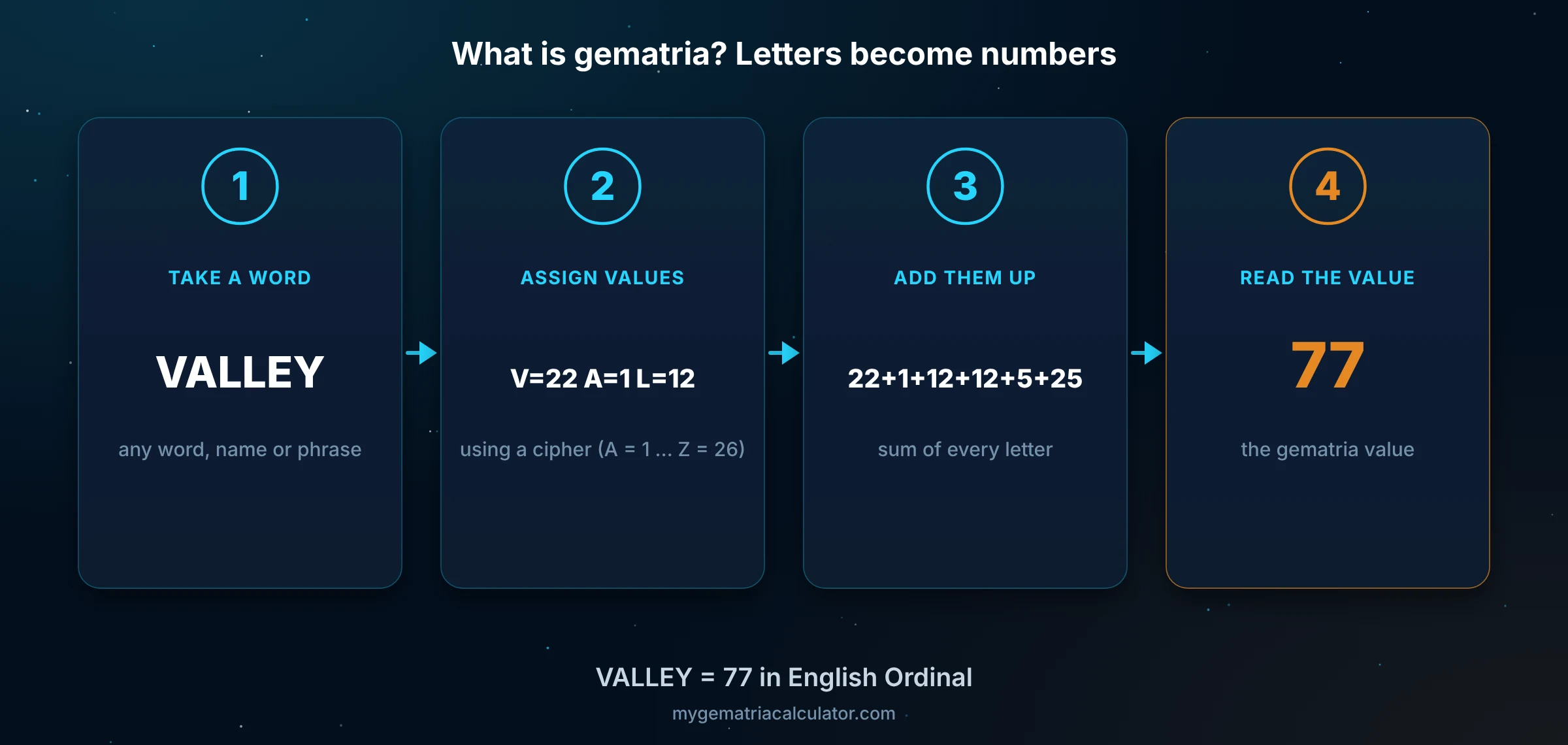
The word Gematria refers to a method of assigning numerical values to letters and using those values to calculate numerical totals for words, names, phrases, or texts. At its core, Gematria is a letter-to-number system (the full mechanics are in how does Gematria work). The process can be represented as:
Letter → Numerical value → Word calculation → Gematria value
A Gematria calculation does not change the spelling or meaning of a word. Instead, it creates a numerical representation based on the selected letter-value system. For example, the word DOG using English Ordinal:
DOG
D = 4
O = 15
G = 7
Calculation
4 + 15 + 7 = 26
DOG = 26 using English Ordinal
The number comes from the calculation method applied to the letters.
Gematria Definition
Gematria is a system that assigns numerical values to letters and uses those values to calculate numerical results for words, names, phrases, or texts.
The exact result depends on:
- The alphabet being used
- The Gematria cipher selected
- The numerical value assigned to each letter
- The word or phrase being calculated
Different Gematria systems can produce different results because they follow different rules for assigning values. For example, the letter C can have different values depending on the system:
| Gematria System | Value of C |
|---|---|
| English Ordinal | 3 |
| Full Reduction | 3 |
| Reverse Ordinal | 24 |
| Reverse Full Reduction | 6 |
The letter remains the same, but the numerical value changes because the calculation system changes.
How Does Gematria Work?
What is gematria in practice? Gematria works by converting letters into numbers according to a defined system. The basic process is:
Text → Individual letters → Letter values → Addition → Numerical result
For example, the word HELLO using English Ordinal:
| Letter | Value |
|---|---|
| H | 8 |
| E | 5 |
| L | 12 |
| L | 12 |
| O | 15 |
| Total | 52 |
Calculation
8 + 5 + 12 + 12 + 15 = 52
The English Ordinal Gematria value of HELLO is 52. The calculation itself is straightforward. The important part is identifying which Gematria cipher was used.
What Is a Gematria System?
What is gematria, technically? A Gematria system is a set of rules that determines how numerical values are assigned to letters. Different systems may use different alphabet orders, different reduction methods, and different numerical patterns. For English Gematria, the systems supported by this calculator are:
- English Ordinal
- Full Reduction
- Reverse Ordinal
- Reverse Full Reduction
Each system creates its own numerical relationship between letters and numbers. For example, the word CAT produces different values:
| Gematria System | Value |
|---|---|
| English Ordinal | 24 |
| Full Reduction | 6 |
| Reverse Ordinal | 57 |
| Reverse Full Reduction | 21 |
The spelling of CAT does not change. Only the letter-value system changes.
What Is a Gematria Cipher?
A Gematria cipher is the specific method used to assign numbers to letters. The cipher acts as the rule behind the calculation. For example:
English Ordinal Cipher
Uses normal alphabet positions.
Example
A = 1
B = 2
C = 3
Z = 26
Reverse Ordinal Cipher
Uses the alphabet in reverse.
Example
A = 26
B = 25
C = 24
Z = 1
Because these ciphers assign different values to letters, they can produce different numerical results for the same word. When discussing a Gematria result, identifying the cipher is important because the number alone does not show how it was created.
English Gematria Explained
What is gematria in English? English Gematria applies Gematria-style calculations to the English alphabet. Unlike historical Hebrew Gematria, English Gematria uses English letters and modern letter-value systems. The four English methods supported by this calculator are:
English Ordinal
Follows standard alphabet order, A = 1 through Z = 26.
Example: WORD
W = 23
O = 15
R = 18
D = 4
= 60
Full Reduction
Converts letter values into a repeating 1–9 pattern.
Example
A = 1
I = 9
J = 1
K = 2
L = 3
Reverse Ordinal
Reverses alphabet positions.
Example
A = 26
B = 25
C = 24
Z = 1
Reverse Full Reduction
Combines reverse alphabet order with reduced values, creating another numerical pattern based on the reversed reduced sequence.
Example
A = 8
B = 7
C = 6
Z = 1
Across all four ciphers, the word WORD gives 60 (English Ordinal), 24 (Full Reduction), 48 (Reverse Ordinal) and 21 (Reverse Full Reduction).
Letter Values Across the Four Ciphers
Here is every letter under each cipher. For a longer walkthrough, see the English Gematria Chart A–Z and step-by-step guide to using the chart.
| Letter | English Ordinal | Full Reduction | Reverse Ordinal | Reverse Full Reduction |
|---|---|---|---|---|
| A | 1 | 1 | 26 | 8 |
| B | 2 | 2 | 25 | 7 |
| C | 3 | 3 | 24 | 6 |
| D | 4 | 4 | 23 | 5 |
| E | 5 | 5 | 22 | 4 |
| F | 6 | 6 | 21 | 3 |
| G | 7 | 7 | 20 | 2 |
| H | 8 | 8 | 19 | 1 |
| I | 9 | 9 | 18 | 9 |
| J | 10 | 1 | 17 | 8 |
| K | 11 | 2 | 16 | 7 |
| L | 12 | 3 | 15 | 6 |
| M | 13 | 4 | 14 | 5 |
| N | 14 | 5 | 13 | 4 |
| O | 15 | 6 | 12 | 3 |
| P | 16 | 7 | 11 | 2 |
| Q | 17 | 8 | 10 | 1 |
| R | 18 | 9 | 9 | 9 |
| S | 19 | 1 | 8 | 8 |
| T | 20 | 2 | 7 | 7 |
| U | 21 | 3 | 6 | 6 |
| V | 22 | 4 | 5 | 5 |
| W | 23 | 5 | 4 | 4 |
| X | 24 | 6 | 3 | 3 |
| Y | 25 | 7 | 2 | 2 |
| Z | 26 | 8 | 1 | 1 |
Why Can the Same Word Have Different Gematria Values?
The same word can have multiple Gematria values because different ciphers assign different numerical values to letters. Example, CAT:
English Ordinal
C = 3
A = 1
T = 20
Total = 24
Reverse Ordinal
C = 24
A = 26
T = 7
Total = 57
The word is identical. The only difference is the calculation system. This is why a complete Gematria result should include:
Word + Cipher + Numerical value
Example
CAT → English Ordinal → 24
This provides enough information for another person to reproduce the calculation.
Where Did Gematria Come From?
What is gematria historically? Gematria is historically associated with Hebrew letters and Jewish textual traditions. In Hebrew Gematria, letters of the Hebrew alphabet are assigned numerical values, and those values have been used in the study and interpretation of Jewish texts, including in rabbinic literature. The word “gematria” itself is generally thought to come from Greek, although scholars debate its exact origin.
Jewish educational sources describe this history in more detail. Chabad.org’s guide to gematria traces the earliest reference to the Baraita of the 32 Rules, which lists gematria as one of the rules for interpreting the Bible, and notes that Pirkei Avot calls it a “condiment of wisdom.” My Jewish Learning’s overview of gematria explains that it appears from time to time in the Talmud and Midrash but was never central to rabbinic literature, while it became essential to Kabbalah, the Jewish mystical tradition.
Historically, letters often served both linguistic and numerical purposes in different cultures, and various letter-number systems developed in different languages and traditions. Modern websites and calculators also use the term Gematria for systems that calculate English words and phrases.
Modern English Gematria is not identical to traditional Hebrew Gematria, because the alphabet, rules, and historical context are different. The English ciphers are modern conventions.
Hebrew Gematria and Greek Isopsephy
Gematria is most commonly associated with Hebrew traditions, but other cultures also developed related letter-number systems.
Hebrew Gematria
Hebrew Gematria assigns numerical values to Hebrew letters and has been used historically in Jewish textual interpretation and study.
The Hebrew alphabet has its own letter-value system, which differs from English Gematria.
Greek Isopsephy
Isopsephy is a Greek practice that assigns numerical values to Greek letters. Like Gematria, it creates relationships between letters and numbers.
Ancient graffiti that adds up letter values, such as examples reported from Pompeii, is often cited as evidence of everyday use.
Greek isopsephy and Hebrew Gematria belong to different languages and historical traditions, so the systems should not be treated as identical.

What Is Gematria Used For?
What is gematria used for? The use of Gematria depends on the historical tradition or the person applying the system. Common uses discussed include:
- Studying numerical relationships between words
- Comparing words with matching values
- Examining names and phrases
- Researching historical texts
- Exploring letter-number systems
Modern users may also use an English Gematria Calculator to calculate words, names, phrases, and sentences. For names specifically, see our guide to calculating the gematria value of a name. The calculation produces a numerical value; any additional interpretation depends on the context in which the number is being examined.
What Is a Gematria Value?
For anyone asking what is gematria, a Gematria value is the numerical result produced after applying a Gematria system to a word, name, phrase, or text.
Example
CAT → English Ordinal → 24
- CAT is the input
- English Ordinal is the cipher
- 24 is the Gematria value
The value comes from adding the numerical values assigned to each letter. If a different cipher is selected, the result can change. To learn how people discuss what such numbers represent, read gematria number meanings.
Gematria and Matching Numerical Values
One common concept associated with Gematria is comparing words or phrases that produce the same numerical value. For example, using English Ordinal:
SCHOOL
→ 72
ROCKET
→ 72
If both calculations use the same cipher, they share the same numerical result. This creates a numerical correspondence. However, the shared number does not automatically mean the words have the same definition or meaning. The relationship exists specifically because the Gematria calculation produced the same value.
Is Gematria the Same as Numerology?
What is gematria compared with numerology? Gematria and numerology both involve numbers, but they are different systems.
Gematria
Gematria begins with letters. Letters are assigned numerical values according to a specific cipher.
Example
WORD → numerical value
Numerology
Numerology generally focuses on the symbolic interpretation of numbers through different calculation methods.
A Gematria calculation may produce a number, but interpreting it through numerology would be a separate process.
Therefore, Gematria and numerology should not automatically be treated as the same practice. Our guide to gematria vs numerology explains the difference in detail.
Gematria vs Gematria Calculator
Gematria and a Gematria Calculator are related but different. Gematria is the calculation system. A Gematria Calculator is a tool that applies that system automatically. A calculator can:
- Accept a word or phrase
- Apply a selected cipher
- Convert letters into values
- Add the numbers
- Display the result
The calculator does not create a new system. It simply performs the Gematria calculation using defined rules. Open the English Gematria Calculator to see all four English results at once, or use the compare tool to compare words side by side.
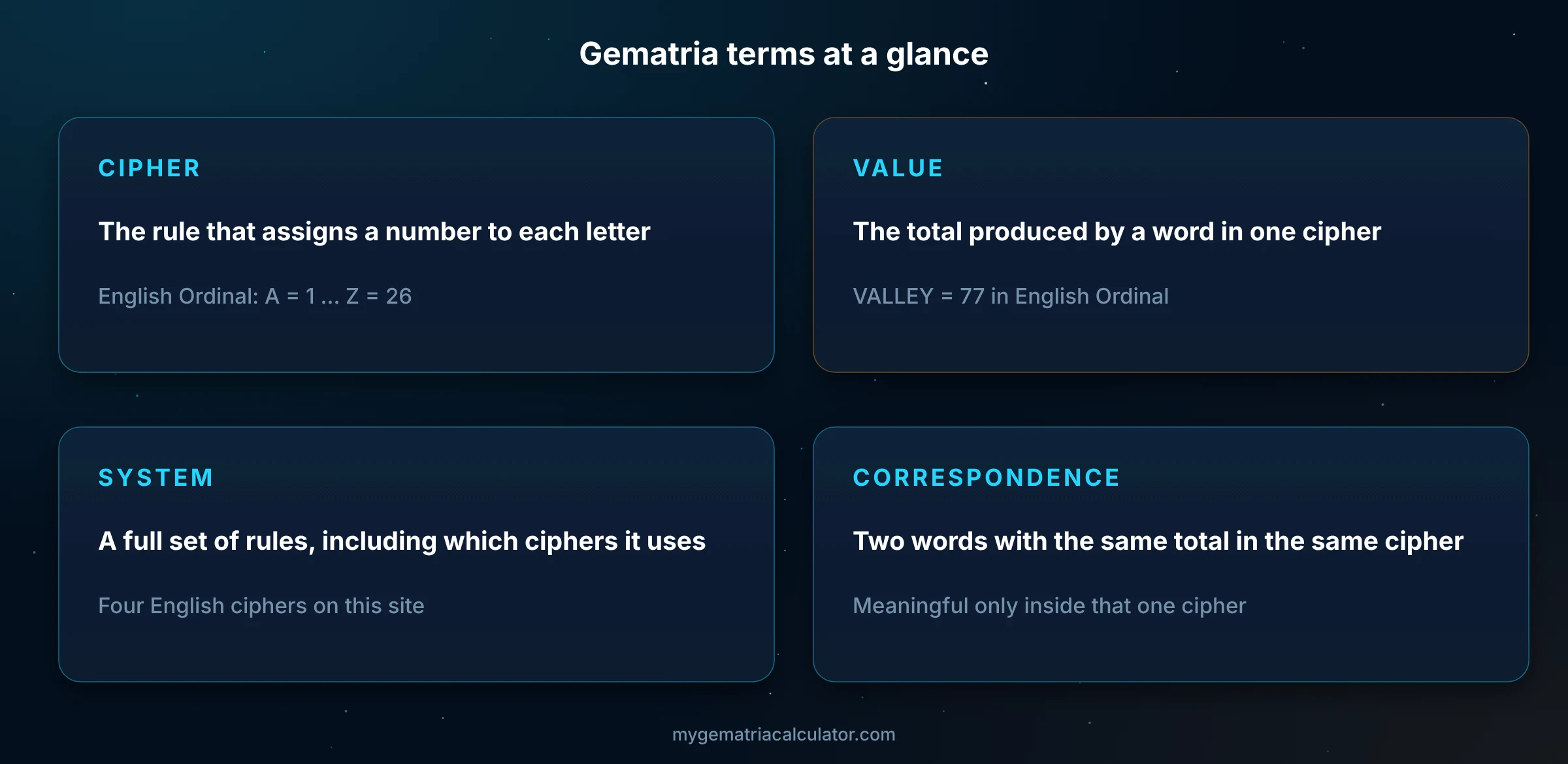
Common Gematria Terms
Understanding these terms answers what is gematria more clearly and makes it easier to follow.
| Term | Meaning |
|---|---|
| Gematria | A system that assigns numerical values to letters |
| Gematria Value | The final numerical result of a calculation |
| Cipher | The specific letter-to-number mapping used |
| Letter Value | The number assigned to an individual letter |
| Gematria Calculation | The process of converting letters into numbers and adding them together |
| Numerical Correspondence | A relationship created when words or phrases share the same calculated value |
Facts, History and Traditional Belief
It helps to separate what can be checked from what is tradition or belief.
| Topic | What it is | Status |
|---|---|---|
| Adding letter values | Arithmetic using a chosen cipher | Verifiable: anyone can repeat it |
| Which cipher to use | A convention chosen by the user or tradition | Not fixed; ciphers differ |
| Hebrew Gematria and Greek isopsephy | Letter-number practices in their own languages | Historical practices; details vary by source |
| English Gematria ciphers | Modern conventions applied to the English alphabet | Modern; not ancient Hebrew practice |
| Meanings attached to numbers | Interpretations by traditions or communities | Belief and tradition; vary by source |
| Revealing hidden truths or predicting events | Claims made in some circles | No scientific evidence supports these claims |
This site calculates letter values. It does not claim that any number reveals hidden meaning, personality, or future events.
Frequently Asked Questions
What is Gematria in simple words?
What is gematria? Gematria is a letter-to-number system where letters receive numerical values that can be used to calculate words, names, phrases, or texts.
What does Gematria mean?
In short, what is gematria? Gematria refers to the practice of assigning numerical values to letters and examining the numerical results produced from words or phrases.
How does Gematria work?
Gematria works by assigning numbers to letters according to a specific cipher and adding those values together to create a numerical result.
Is Gematria the same as numerology?
No. Gematria focuses on converting letters into numbers, while numerology uses different systems for interpreting numbers.
Can English words be calculated using Gematria?
Yes. English Gematria systems assign numerical values to English letters and can be used to calculate words, names, and phrases.
Why does the same word have different Gematria values?
Different Gematria ciphers assign different values to letters, which changes the final calculation result.
What is a Gematria cipher?
A Gematria cipher is the rule system that determines how letters are converted into numerical values.
What is Gematria used for?
Gematria has been used for studying numerical relationships between letters, words, names, and texts in different traditions and modern applications.
Is Gematria scientifically proven to reveal meaning?
No. The arithmetic can be checked, but claims that the resulting numbers reveal hidden meaning or predict events are beliefs, not scientifically established facts.
Where can I calculate Gematria?
Enter a word or name in the English Gematria Calculator to see all four English cipher results.
Final Takeaway
So, what is Gematria? Gematria is a system that connects letters and numbers by assigning numerical values to letters and using those values to calculate words, names, phrases, and texts.
The basic process is: letters, then numerical values, then calculation, then a Gematria value. The final result depends on the selected alphabet, Gematria cipher, and calculation method.
English Gematria commonly uses English Ordinal, Full Reduction, Reverse Ordinal and Reverse Full Reduction, while Hebrew Gematria and Greek isopsephy follow their own historical and linguistic systems. Understanding the relationship between letters, numbers, and calculation methods provides the foundation for exploring Gematria in a clear and structured way.
Now you can answer what is gematria; ready to try it? Open the English Gematria Calculator, or keep learning with how to use a Gematria calculator and gematria vs numerology.
About this guide
Written and maintained by the My Gematria Calculator editorial team. Every value is added up from the fixed English Gematria chart A–Z. Read our editorial policy and methodology. Last reviewed 31 October 2026.