Gematria Knowledge Base
Gematria vs Numerology: What Is the Difference? Origins, Methods and Examples
Two number systems, two different starting points
Published by
/
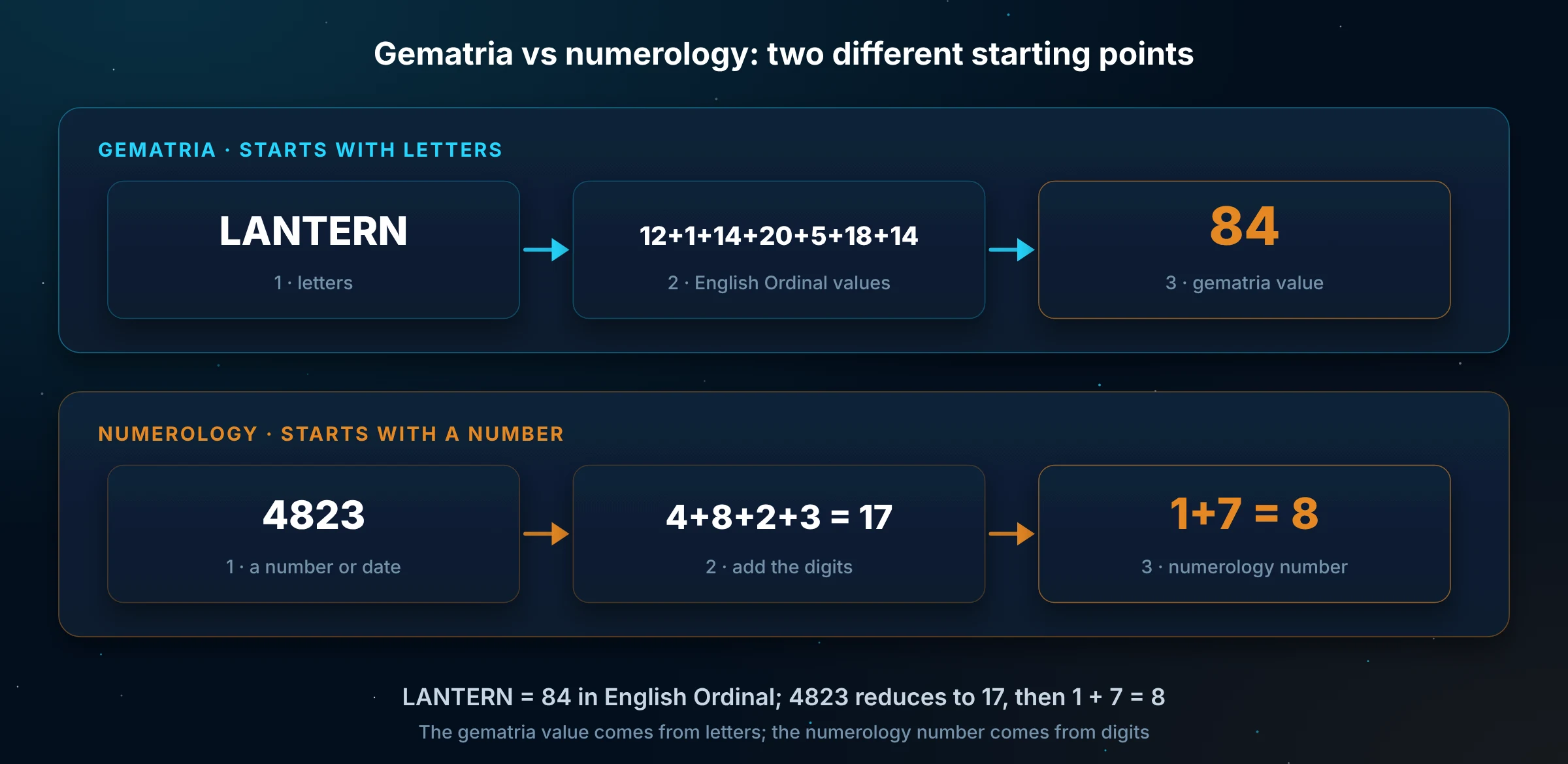
Gematria vs numerology: both are systems that involve numbers, but they use numbers in different ways.
The main difference is:
Gematria
Starts with letters and assigns numerical values to them.
Numerology
Starts with numbers or numerical information and applies a system of calculation and interpretation.
Gematria is a letter-to-number system where words, names, phrases, or texts are converted into numerical values using a specific cipher. Numerology is a broader practice focused on the calculation and interpretation of numbers according to a particular numerological framework.
In gematria vs numerology, although both topics involve numbers, their starting points, calculation methods, and purposes are different. Only the arithmetic is verifiable; the symbolic meanings attached to numbers are beliefs and traditions, not scientific findings.
New to gematria? Start with how to use a Gematria calculator, browse the English Gematria Chart A–Z, or read about calculating the value of a name and gematria number meanings.
Contents
Gematria vs Numerology: Quick Comparison
| Feature | Gematria | Numerology |
|---|---|---|
| Starting point | Letters | Numbers or numerical information |
| Main focus | Letter values and numerical totals | Number calculation and interpretation |
| Input | Words, names, phrases, texts | Numbers, dates, names, or other inputs depending on the system |
| Main tool | Gematria cipher | Numerology calculation method |
| Result | Gematria value | Numerological number |
| Main question | “What numerical value does this word produce?” | “What does this number represent in this system?” |
The exact practices can vary depending on the specific Gematria or numerology system being used, but this gematria vs numerology comparison explains the basic difference.
For background on both sides of gematria vs numerology, see the Britannica entry on gematria, the Wikipedia article on gematria and the Wikipedia article on numerology.
What Is Gematria?
Gematria is a system that assigns numerical values to letters and uses those values to calculate words, names, phrases, or texts. The process is:
Letters → Numerical values → Calculation → Gematria value
In English Gematria, a cipher determines the value assigned to each letter. Using English Ordinal, A = 1, B = 2, C = 3, and so on through Z = 26. Consider the word CAT:
CAT
C = 3
A = 1
T = 20
Calculation
3 + 1 + 20 = 24
CAT = 24 using English Ordinal
The number 24 is the gematria value produced by that specific calculation method.
What Is Numerology?
Numerology is a system that focuses on numbers and their interpretation according to a particular framework. It commonly works with numerical information such as:
- Dates
- Names
- Existing numbers
- Calculated numerical patterns
Different numerology systems use different calculation rules. For example, a system may reduce a number by adding its digits:
Digit reduction
24 → 2 + 4 = 6
The resulting number may then be interpreted according to that specific system. The calculation method and the interpretation both depend on the numerology approach being used.
Key Difference Between Gematria and Numerology
The biggest difference in gematria vs numerology is where the number comes from.
Gematria
Gematria asks: “What numerical value do these letters produce?”
DOG
D = 4
O = 15
G = 7
4 + 15 + 7 = 26
The number comes directly from the values assigned to the letters.
Numerology
Numerology asks: “What does this calculated number represent within this system?”
A numerology calculation may begin with a birth date, a name, or another numerical input.
The number is then processed and interpreted according to the rules of that numerology method.
How Gematria Uses Letter Values
Gematria depends on a letter-value system. A cipher determines how letters are converted into numbers. The four English methods supported by this calculator are:
English Ordinal
Uses normal alphabet positions.
Example
A = 1
B = 2
C = 3
Z = 26
Full Reduction
Uses a repeating 1–9 pattern.
Example
A = 1
B = 2
I = 9
J = 1
Reverse Ordinal
Uses reverse alphabet values.
Example
A = 26
B = 25
C = 24
Z = 1
Reverse Full Reduction
Uses reduced values combined with the reverse alphabet order.
Example
A = 8
B = 7
C = 6
Z = 1
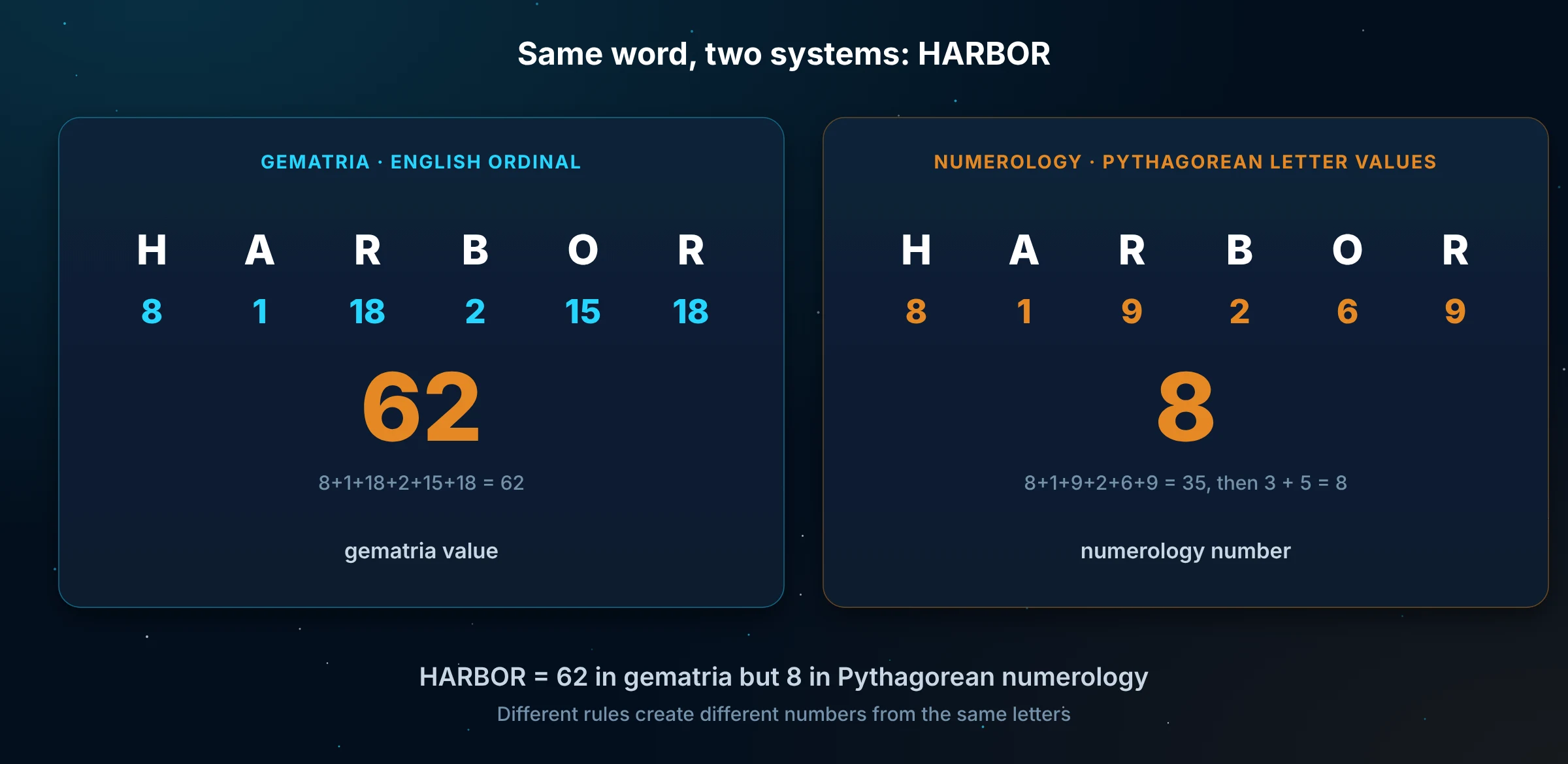
Because these systems assign different values to letters, the same word can produce different Gematria results. For example, CAT:
| Method | Value |
|---|---|
| English Ordinal | 24 |
| Full Reduction | 6 |
| Reverse Ordinal | 57 |
| Reverse Full Reduction | 21 |
The word remains the same. Only the calculation method changes. Here are more words across all four methods:
| Word | English Ordinal | Full Reduction | Reverse Ordinal | Reverse Full Reduction |
|---|---|---|---|---|
| CAT | 24 | 6 | 57 | 21 |
| DOG | 26 | 17 | 55 | 10 |
| HELLO | 52 | 25 | 83 | 20 |
| ANNA | 30 | 12 | 78 | 24 |
| DAVID | 40 | 22 | 95 | 32 |
You can check any of these in the English Gematria Calculator, which shows all four totals together. See how to use a Gematria calculator for a walkthrough.
How Numerology Uses Numbers
In gematria vs numerology, numerology generally begins with a number or creates a number through a specific calculation method. Depending on the system, it may use:
- Birth dates
- Names
- Numerical patterns
- Reduced numbers
For example, a numerology method may take a number and reduce it:
Digit reduction
33 → 3 + 3 = 6
The resulting number may then be interpreted according to that numerological framework.
Note that some numerology systems also convert the letters of a name into digits. The Pythagorean method, for instance, repeats the digits 1–9 across the alphabet, which resembles the Full Reduction cipher. What sets the two practices apart is the overall framework: numerology typically reduces results to a single digit and interprets them within a numerological system, while gematria records the calculated total under a named cipher.
Origins: Where Each Practice Comes From
In gematria vs numerology, both practices are old ideas with modern forms, and it helps to separate documented history from tradition.
Gematria
Gematria is generally associated with Hebrew-language traditions, where letters double as numerals and numerical totals of words have been compared in rabbinic literature. A similar practice in ancient Greek is often called isopsephy.
English Gematria is a modern adaptation. It applies the same idea to the English alphabet using several ciphers, and these ciphers are conventions chosen by their users.
Numerology
Numerology draws on older ideas about the symbolism of numbers. These are often linked to the Greek thinker Pythagoras, but many such attributions are traditional rather than firmly documented.
The word “numerology” itself is generally considered a modern term, and today it covers many different systems with different rules.
Because practices and systems vary widely, this guide describes how each is commonly explained rather than claiming a single official version of either.
Similarities Between Gematria and Numerology
In gematria vs numerology, the two are different systems, yet they have some similarities. Both may involve:
- Numbers
- Names
- Calculation methods
- Symbolic interpretation
- Numerical patterns
Both can also involve personal names or words in certain contexts. However, the way the number is created is different.
Gematria
Letters → Values → Numerical result
Numerology
Numerical input → Calculation → Number interpretation
The starting point determines the type of system being used.
Is Gematria a Type of Numerology?
Gematria vs numerology comes up often because both involve numbers and interpretation. However, they are not identical systems.
Gematria has its own letter-based numerical framework. It begins with letters and uses a cipher to assign values. Numerology has its own calculation methods focused on numbers and their interpretation. Some people compare the two or use them together, but the calculation process behind each system remains different.
Gematria Number vs Numerology Number
In gematria vs numerology, a gematria number is generally the numerical result produced from applying a Gematria cipher to letters.
Example
CAT → English Ordinal → 24
- CAT is the input
- English Ordinal is the cipher
- 24 is the Gematria value
A numerology number is a number produced through a numerological calculation system. The source of the number matters. Two numbers may both be 24, but they may represent completely different calculations: one may come from letter values, the other from a numerology calculation. The method determines what the number represents.
Gematria and Numerology Names
Names are one area where gematria vs numerology can appear similar. A name can be calculated using Gematria by assigning numerical values to its letters. Example, ANNA using English Ordinal:
ANNA
A = 1
N = 14
N = 14
A = 1
Calculation
1 + 14 + 14 + 1 = 30
ANNA = 30 using English Ordinal
This is a Gematria calculation because the number comes from letter values. Numerology may also use names in some systems, but the calculation rules are different. The same name can therefore produce different results depending on whether a Gematria cipher or a numerology method is applied. For more, see our guide to calculating the gematria value of a name.
Gematria and Birth Dates
In gematria vs numerology, birth dates are commonly associated with numerology rather than standard English Gematria. A numerology system may use the digits in a birth date to create a calculated number, combining or reducing them according to its own rules.
This differs from English Gematria because English Gematria is based on:
English Gematria
Letters → Numerical values
Birth-date numerology
Dates → Number calculation
This difference is one of the clearest ways to separate gematria vs numerology.
Gematria, Numerology, and Number Meanings
In gematria vs numerology, both can involve discussions about number meanings, but the context is different.
In Gematria
A number usually represents the calculated value of letters.
HELLO → 52 using English Ordinal
In numerology
A number may be interpreted according to a numerological framework.
The number 52 is the result of the letter calculation. The same number can appear in both topics while being created through different methods, so the calculation method should always be identified before discussing any interpretation. Our guide to gematria number meanings explains how to keep calculation and interpretation separate.
Why Can the Same Number Appear in Both Systems?
A Gematria calculation and a numerology calculation may sometimes produce the same number, for example 33 in both. That does not mean they were created in the same way.
Gematria
Letters → Values → Total
Numerology
Numerical input → Calculation → Result
The method used to create the number determines its context.
Gematria Cipher vs Numerology Calculation
In gematria vs numerology, a Gematria cipher defines how letters receive numerical values. In English Ordinal, A = 1, B = 2, C = 3. A numerology system uses its own calculation rules. When recording a result, it is useful to include the method:
Gematria
Input + Cipher + Result
CAT + English Ordinal + 24
Numerology
Input + Numerology Method + Result
This makes the calculation easier to understand and verify.
Can Gematria and Numerology Be Used Together?
Some people compare gematria vs numerology because both involve numerical analysis. For example, someone may calculate:
- A name using Gematria
- The same name using a numerology system
These are two separate calculations. The Gematria result comes from a letter-value cipher. The numerology result comes from a numerological calculation method. If both are discussed together, the methods should remain separate rather than combining the numbers automatically.
Example: Same Name, Different Systems
For gematria vs numerology, consider the name DAVID using English Ordinal Gematria:
| Letter | Value |
|---|---|
| D | 4 |
| A | 1 |
| V | 22 |
| I | 9 |
| D | 4 |
| Total | 40 |
Calculation
4 + 1 + 22 + 9 + 4 = 40
DAVID = 40 using English Ordinal. This is a Gematria result. In the other three ciphers, DAVID gives 22 (Full Reduction), 95 (Reverse Ordinal) and 32 (Reverse Full Reduction).
A numerology calculation using the same name would follow a different process and may produce a different number. The two results should not be treated as the same calculation.
Facts, History and Symbolic Belief
In gematria vs numerology, it helps to separate what can be checked from what is tradition or belief.
| Topic | What it is | Status |
|---|---|---|
| Adding letter values | Arithmetic using a chosen cipher | Verifiable: anyone can repeat it |
| Which cipher to use | A convention chosen by the user or tradition | Not fixed; ciphers differ |
| Digit reduction (24 → 6) | Arithmetic rule | Verifiable as math |
| Historical use | Documented in some traditions, such as Hebrew-language texts | Historical record; details vary by source |
| Number meanings | Symbolic interpretations | Belief and tradition; vary by source |
| Predicting personality or events | Claims made in some circles | No scientific evidence supports these claims |
This site calculates letter values. It does not measure personality, destiny, or future events, and neither gematria nor numerology is a scientific method for doing so.
Common Confusion Between Gematria and Numerology
“They Both Use Numbers, So They Are the Same”
Not necessarily. Gematria focuses on assigning numerical values to letters. Numerology focuses on number calculation and interpretation.
“A Gematria Value Is Automatically a Numerology Number”
A Gematria value is a number, but it is not automatically a numerology result. The calculation method determines the system.
“The Same Number Has the Same Meaning Everywhere”
A number’s context depends on how it was created. The same number can have different meanings in different systems.
“All Gematria Uses the Same Letter Values”
Different Gematria ciphers can assign different values to letters.
“Names Are Calculated the Same Way in Both Systems”
A name may be used in both systems, but the calculation rules are different.
When Should You Use Gematria?
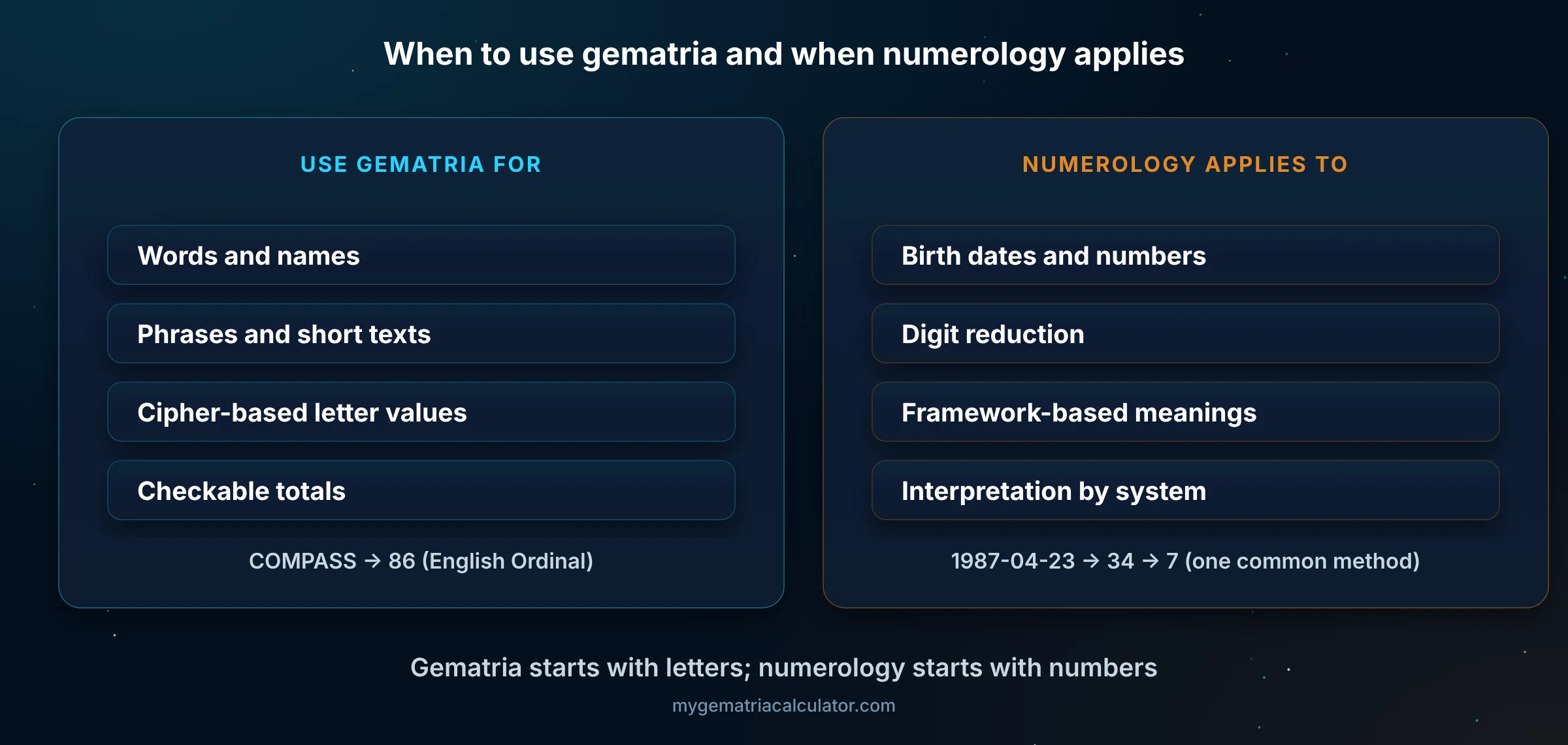
In gematria vs numerology, Gematria is useful when you want to examine the numerical value of words, names, phrases, or texts according to a specific letter-value system. For example, you may want to:
- Calculate a word’s numerical value
- Compare two phrases
- Explore matching numerical values
- Study letter-number relationships
An English Gematria Calculator can automate the calculation process. Try the English Gematria Calculator, or use the compare tool to see several results side by side.
When Is Numerology Relevant?
In gematria vs numerology, numerology is relevant when exploring numbers through a specific numerological framework. Depending on the system, this may involve:
- Birth dates
- Names
- Numerical patterns
- Reduced numbers
- Number symbolism
The exact process depends on the numerology method being used. This site does not offer a numerology calculator; it covers English Gematria only.
Frequently Asked Questions
What is the difference between Gematria and numerology?
Gematria assigns numerical values to letters and calculates values for words, names, and phrases. Numerology uses number-based systems to calculate and interpret numbers.
Is Gematria the same as numerology?
No. Gematria vs numerology is not the same thing: they both involve numbers, but they use different calculation methods and have different foundations.
Is Gematria a type of numerology?
Gematria is generally considered a separate letter-number system, although both topics may be discussed together because they involve numerical analysis.
Can the same name have a Gematria value and a numerology number?
Yes. The same name can be calculated using both systems, but each result comes from a different method.
Does Gematria use birth dates?
Standard English Gematria calculations are based on letters rather than birth dates. Birth-date calculations are more commonly associated with numerology.
Why is the calculation method important?
The method determines how the number is produced. Different systems can create different results from the same input.
Can Gematria and numerology produce the same number?
Yes. Different calculation systems can sometimes produce the same numerical result, but the meaning depends on how the number was generated.
Is there scientific evidence that gematria or numerology predicts anything?
No. The arithmetic can be checked, but claims that the resulting numbers reveal personality or predict events are beliefs, not scientifically established facts.
Where can I calculate a gematria value?
Enter a word or name in the English Gematria Calculator to see all four English cipher results.
Final Takeaway
Gematria vs numerology comes down to this: both involve numbers, but they are different systems. Gematria begins with letters and assigns them numerical values through a specific cipher: letters, then numerical values, then a gematria value. Numerology generally begins with numbers or numerical information and applies a calculation and interpretation framework.
The simplest way to remember the gematria vs numerology difference: Gematria = letter-based calculation and Numerology = number-based interpretation.
When researching gematria vs numerology, always identify the method used to create the number. The calculation process determines what the final result represents. Ready to try it? Open the English Gematria Calculator, or continue with how to use an English Gematria chart and gematria number meanings.
About this guide
Written and maintained by the My Gematria Calculator editorial team. Every value is added up from the fixed English Gematria chart A–Z. Read our editorial policy and methodology. Last reviewed 31 October 2026.