Gematria Knowledge Base
How Does Gematria Work? Letters to Numbers, Ciphers and Calculation Explained
A step-by-step look at how letters become numbers
Published by
/
How does Gematria work? Gematria works by assigning numerical values to letters and combining those values to calculate a numerical result for a word, name, phrase, or text.
Letters → Numerical values → Calculation → Gematria value
A Gematria system uses a specific set of rules, known as a Gematria cipher, to decide how each letter receives its number. For example, using the English Ordinal method:
SUNRISE
S = 19
U = 21
N = 14
R = 18
I = 9
S = 19
E = 5
Calculation
19 + 21 + 14 + 18 + 9 + 19 + 5 = 105
SUNRISE = 105 using English Ordinal
The word itself does not contain a fixed number. The number 105 is the Gematria value produced by applying one specific letter-number system, and the final result depends on the calculation method being used.
This guide focuses on the process itself. If you want the definition and background first, start with What Is Gematria?. You can follow every example below in the English Gematria Calculator, and the English Gematria Chart A–Z lists every letter value.
Contents
For background on the idea behind the method, see the Britannica entry on gematria and the Wikipedia article on gematria, which describe how letters carry numerical value in Hebrew and Greek traditions.
What Is the Basic Principle Behind Gematria?
The basic principle is that letters can be represented by numbers through a defined numerical system. Instead of treating letters only as written symbols, Gematria connects each one to a number, and the numbers are then combined to give a result for the whole word. New to the topic? Start with what Gematria is, then keep the English Gematria chart A–Z handy.
Letter → Number → Word → Numerical result
Every Gematria method sets its own rules for assigning values. In English Ordinal, A = 1, B = 2, C = 3, D = 4, and so on until Z = 26. Once each letter has a value, the numbers are added to find the total for the word. Example:
WORD
W = 23
O = 15
R = 18
D = 4
Calculation
23 + 15 + 18 + 4 = 60
WORD = 60 using English Ordinal
This is the basic mechanism behind every Gematria calculation, and it is the short answer to how does gematria work: each letter gets a number, and the numbers are added.
How Are Letters Assigned Numerical Values?
Letters receive numerical values according to the selected Gematria method, also called a cipher. A cipher is a set of rules that determines the relationship between letters and numbers, and different ciphers can assign different values to the same letter. For example, the letter M:
| Gematria Method | Value of M |
|---|---|
| English Ordinal | 13 |
| Full Reduction | 4 |
| Reverse Ordinal | 14 |
| Reverse Full Reduction | 5 |
The letter M remains the same. Only the numerical system changes. This is why a Gematria calculation should always mention the method used. A complete result includes:
Word + Gematria method + Numerical value
Example
M = 13 using English Ordinal
How Is a Gematria Calculation Performed?
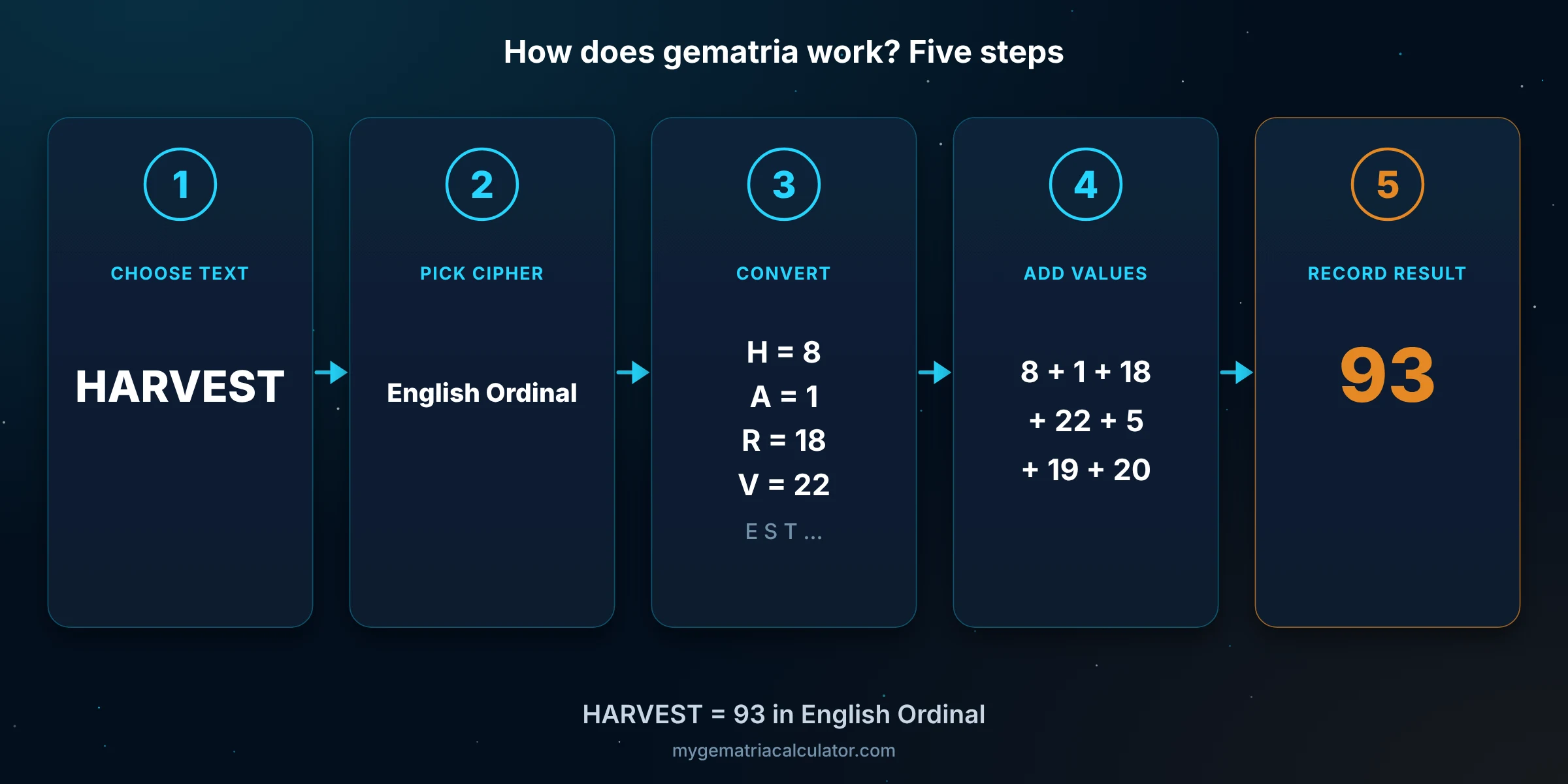
A Gematria calculation follows a simple five-step process, and these five steps explain how does gematria work from start to finish. The worked example below uses HELLO.
Step 1: Choose the Text
First, select the word, name, phrase, or text you want to calculate. Examples:
- MOUNTAIN
- HELLO
- DAVID
- HELLO WORLD
The spelling matters because the calculation depends on the letters entered. When you ask how does gematria work for a single word, check the spelling first.
Step 2: Select a Gematria Method
Choose the numerical system you want to use. The four English Gematria methods supported by this calculator are:
- English Ordinal
- Full Reduction
- Reverse Ordinal
- Reverse Full Reduction
Each method uses different letter values.
Step 3: Convert Letters Into Numbers
The selected method assigns a numerical value to each letter. Using English Ordinal:
HELLO
H = 8
E = 5
L = 12
L = 12
O = 15
Step 4: Add the Letter Values
The individual values are added together.
Calculation
8 + 5 + 12 + 12 + 15 = 52
HELLO = 52 using English Ordinal
Step 5: Record the Result
A complete Gematria result should include three things:
- The original text
- The selected method
- The final numerical value
Example
HELLO → English Ordinal → 52
This makes the calculation clear and easy to verify.
Example: How Gematria Works With a Word
Let us use a more complex example. Word: MOUNTAIN, using English Ordinal.
| Letter | Value |
|---|---|
| M | 13 |
| O | 15 |
| U | 21 |
| N | 14 |
| T | 20 |
| A | 1 |
| I | 9 |
| N | 14 |
| Total | 107 |
MOUNTAIN is a good test word because it has eight letters, a repeated letter (N appears twice, so it is counted twice) and letters from the start, middle and end of the alphabet. Each letter is converted separately, then the eight values are added together.
Calculation
13 + 15 + 21 + 14 + 20 + 1 + 9 + 14 = 107
MOUNTAIN = 107
Now compare the same word using all four methods:
| Gematria Method | Result |
|---|---|
| English Ordinal | 107 |
| Full Reduction | 35 |
| Reverse Ordinal | 109 |
| Reverse Full Reduction | 46 |
The input remains MOUNTAIN. Only the Gematria method changes.
How Do Different Gematria Methods Work?
Different Gematria methods use different numerical patterns. Here is how each of the four works, with MOUNTAIN as the example.
English Ordinal
Follows the normal alphabet order, so the value is the letter’s alphabet position: A = 1, B = 2, C = 3 … Z = 26. It is often considered the simplest method.
Example: MOUNTAIN
M = 13
O = 15
U = 21
N = 14
T = 20
A = 1
I = 9
N = 14
Total = 107
Full Reduction
Reduces alphabet values into numbers from 1 to 9. A–I are 1–9, then the sequence repeats: J = 1, K = 2, L = 3, and so on.
Example: MOUNTAIN
M = 4
O = 6
U = 3
N = 5
T = 2
A = 1
I = 9
N = 5
Total = 35
Reverse Ordinal
Reverses the alphabet order. Instead of A = 1, B = 2, C = 3, it uses A = 26, B = 25, C = 24, until Z = 1.
Example: MOUNTAIN
M = 14
O = 12
U = 6
N = 13
T = 7
A = 26
I = 18
N = 13
Total = 109
Reverse Full Reduction
Combines reverse alphabet order with reduced values. It begins A = 8, B = 7, C = 6, D = 5, E = 4, F = 3, G = 2, H = 1, I = 9, then continues the same pattern.
Example: MOUNTAIN
M = 5
O = 3
U = 6
N = 4
T = 7
A = 8
I = 9
N = 4
Total = 46
Behind these patterns the rules are simple. For a letter in alphabet position n (A = 1 to Z = 26), English Ordinal uses n, Full Reduction reduces n to a single digit from 1 to 9, Reverse Ordinal uses 27 − n, and Reverse Full Reduction reduces 27 − n to a single digit. The English Gematria Chart A–Z shows the result for every letter.
The Four Ciphers Compared
This table puts the four supported ciphers side by side, using the same letters and words so the differences are easy to see.
| Cipher | How a letter gets its value | A | M | Z | MOUNTAIN | HELLO |
|---|---|---|---|---|---|---|
| English Ordinal | Alphabet position | 1 | 13 | 26 | 107 | 52 |
| Full Reduction | Position reduced to 1–9 | 1 | 4 | 8 | 35 | 25 |
| Reverse Ordinal | 27 minus position | 26 | 14 | 1 | 109 | 83 |
| Reverse Full Reduction | 27 minus position, reduced to 1–9 | 8 | 5 | 1 | 46 | 20 |
To see how each cipher builds up a full word, here is HELLO letter by letter:
| Letter | English Ordinal | Full Reduction | Reverse Ordinal | Reverse Full Reduction |
|---|---|---|---|---|
| H | 8 | 8 | 19 | 1 |
| E | 5 | 5 | 22 | 4 |
| L | 12 | 3 | 15 | 6 |
| L | 12 | 3 | 15 | 6 |
| O | 15 | 6 | 12 | 3 |
| Total | 52 | 25 | 83 | 20 |
You can run the same comparison on any two words with the compare tool, or enter a single word in the calculator to see all four totals at once.
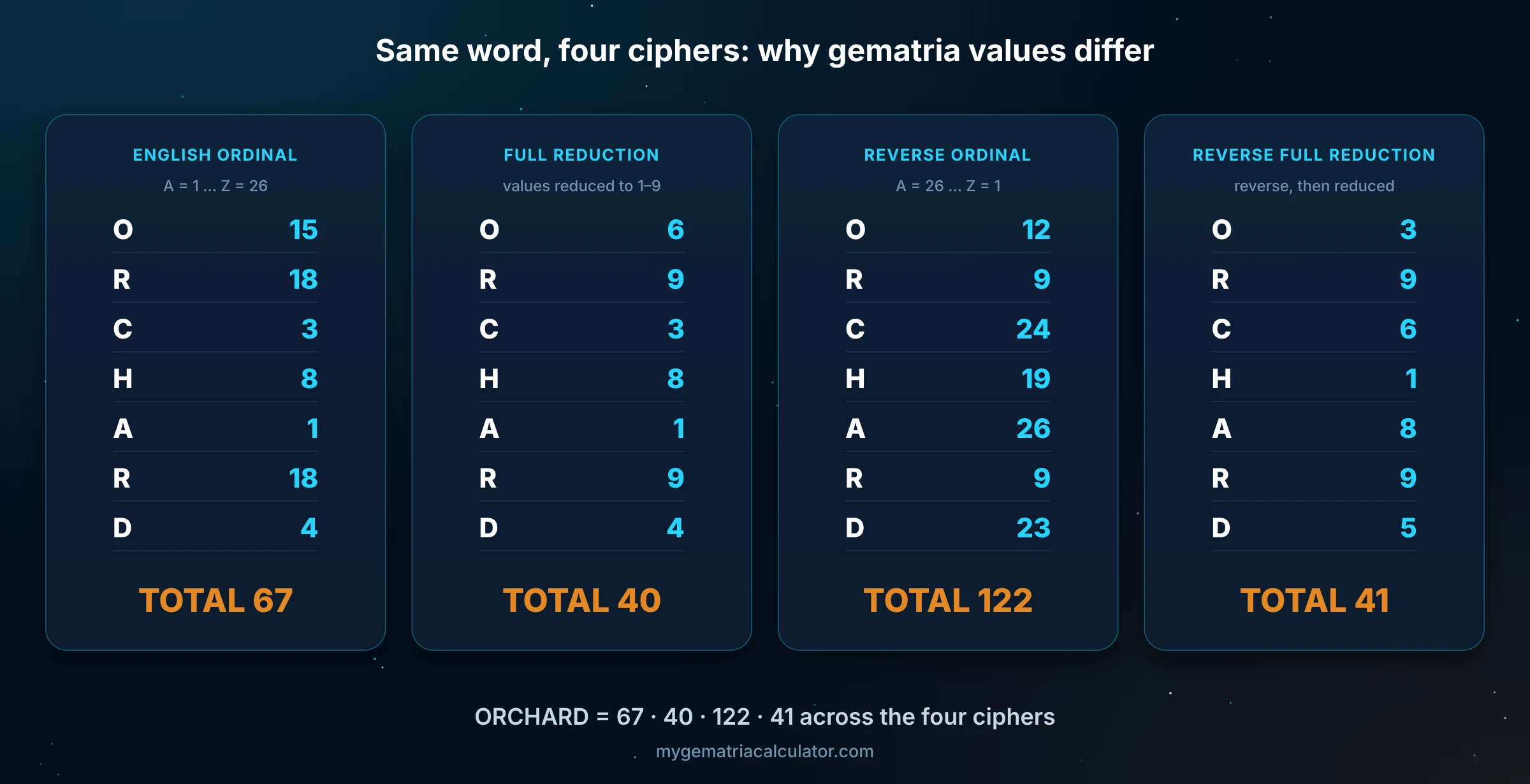
Why Does the Same Word Have Different Gematria Values?
The same word can have different Gematria values because different methods assign different numbers to letters. Take the word DOG:
| Method | D | O | G | Total |
|---|---|---|---|---|
| English Ordinal | 4 | 15 | 7 | 26 |
| Full Reduction | 4 | 6 | 7 | 17 |
| Reverse Ordinal | 23 | 12 | 20 | 55 |
| Reverse Full Reduction | 5 | 3 | 2 | 10 |
The word has not changed. The calculation rules have changed. This difference is the key to how does gematria work when one word is run through four ciphers. This is why a statement like “DOG equals 26” should include the method: “DOG equals 26 using English Ordinal.”
Quick recap: how does gematria work in one line? Each letter gets a number from the chosen cipher, and the numbers are added. How does gematria work for a long word such as MOUNTAIN? The process does not change, you simply add more values. How does gematria work when a letter repeats? The repeated letter is counted every time it appears. How does gematria work in a different cipher? The letters stay the same and only the number rules change.
How Does Gematria Work With Names?
Names are calculated using the same process as words, so if you wonder how does gematria work for names, the steps above already answer it. A name is separated into individual letters, and each letter receives a numerical value. Example, DAVID using English Ordinal:
DAVID
D = 4
A = 1
V = 22
I = 9
D = 4
Calculation
4 + 1 + 22 + 9 + 4 = 40
DAVID = 40 using English Ordinal
Across all four methods, DAVID gives 40 (English Ordinal), 22 (Full Reduction), 95 (Reverse Ordinal) and 32 (Reverse Full Reduction). Changing the spelling of a name can change the result, because Gematria depends on the letters being calculated. For more, read how to calculate the Gematria value of a name.
How Does Gematria Work With Phrases?
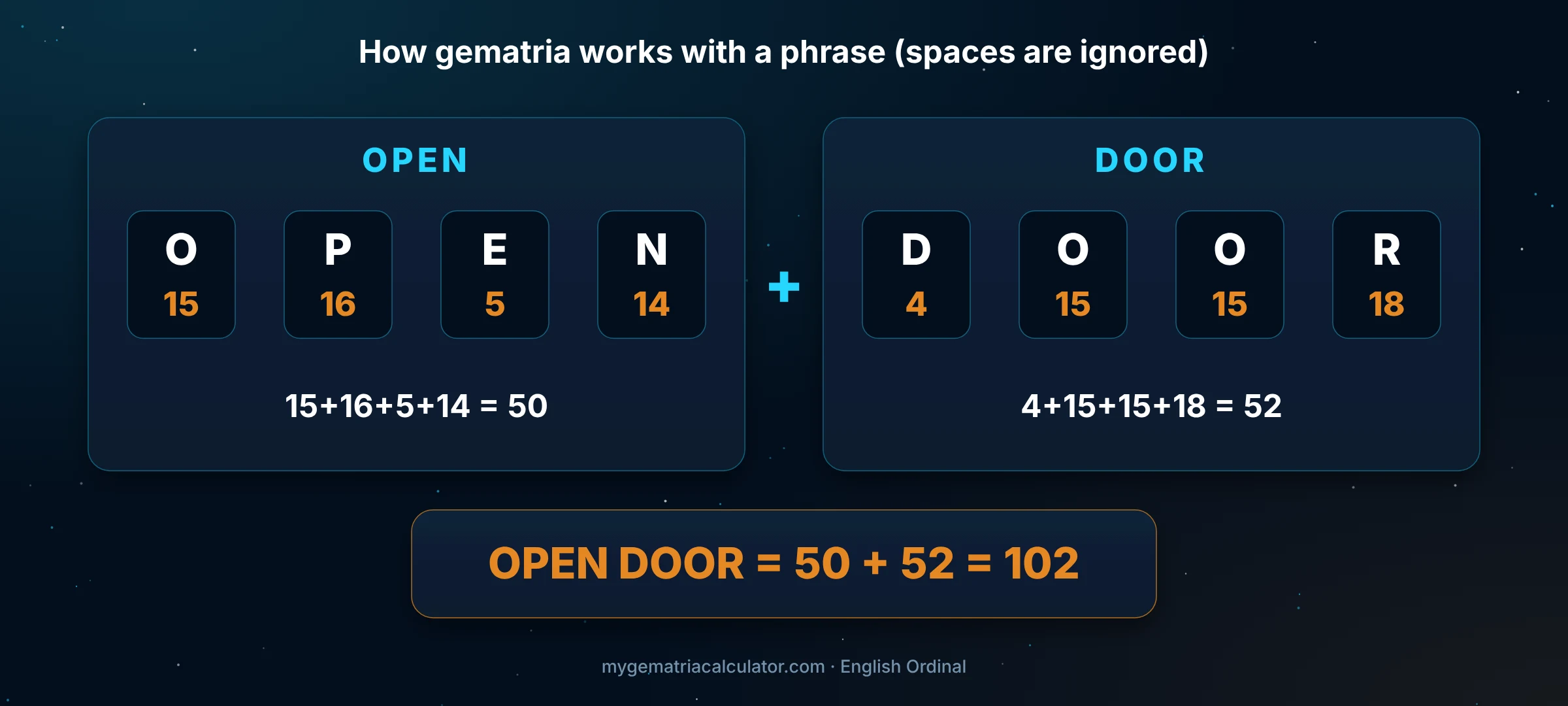
Gematria can also be applied to phrases. How does gematria work for a phrase? The same five steps apply to every word in it. The process stays the same:
Phrase → Letters → Values → Total
Take HELLO WORLD. The calculator evaluates the letters in both words. Spaces are not assigned numerical values because they are not letters, so the calculation uses HELLO + WORLD rather than counting the space between them.
| Method | HELLO | WORLD | HELLO WORLD |
|---|---|---|---|
| English Ordinal | 52 | 72 | 124 |
| Full Reduction | 25 | 27 | 52 |
| Reverse Ordinal | 83 | 63 | 146 |
| Reverse Full Reduction | 20 | 27 | 47 |
Each phrase total is simply the sum of its word totals, so longer phrases use the same letter-value system.
Gematria Calculation Formula
The basic formula behind Gematria is:
Letter Value 1 + Letter Value 2 + Letter Value 3 + … = Gematria Value
Example: SUNRISE
S + U + N + R + I + S + E
19 + 21 + 14 + 18 + 9 + 19 + 5 = 105
The formula itself is simple, which is why how does gematria work is easy to learn from one worked example. The part that changes is the method used to determine each letter value.
Beginners often ask how does gematria work without a calculator. You only need the alphabet and simple addition: write the letters, note each value and add them up. Knowing how does gematria work by hand also lets you check an online result, because a wrong total usually means a skipped or doubled letter. Practising how does gematria work on a few words makes every cipher easier to read.
How Does a Gematria Calculator Apply This Process?
A Gematria calculator follows the same principles but performs the calculation automatically. Instead of finding each letter value by hand, writing down numbers and adding them, the calculator:
- Receives the input text
- Applies the selected Gematria method
- Assigns values to letters
- Adds the values
- Displays the final result
A calculator does not change how Gematria works. People who ask how does gematria work online usually want this automation. It automates the same letter-number process. Try it in the English Gematria Calculator, and see how to use a Gematria calculator for a walkthrough of the tool.
Calculation vs. Interpretation
It helps to separate the part of Gematria that is arithmetic from the part that is symbolic.
| Part of the process | What it is | Status |
|---|---|---|
| Assigning letter values | Following the rules of the chosen cipher | Mathematical: anyone can repeat it |
| Adding the values | Ordinary addition | Mathematical: the same input and cipher always give the same total |
| Choosing a cipher | A convention picked by the user or tradition | Not fixed; different ciphers give different totals |
| Attaching meaning to a total | Interpretation by a tradition, community or individual | Symbolic belief; varies by source |
| Claims that totals reveal hidden truths or predict events | Claims made in some circles | No scientific evidence supports these claims |
This guide, and this calculator, deal with the calculation only. Any interpretation of a number is separate from the process, and is not a scientifically established fact. See Gematria number meanings and Gematria vs. numerology for more on how interpretations are discussed.
In short, how does gematria work as arithmetic? It depends on only two choices: the cipher and the spelling. Ask how does gematria work again with a new word and you will follow the same path each time. That repeatable path is also why how does gematria work is a calculation question first, and an interpretation question only afterwards. Avoid the common mistakes below and your results will stay consistent.
Common Mistakes When Understanding How Gematria Works
Assuming Every Word Has One Fixed Number
A word does not have one permanent Gematria value. The result depends on the selected method.
Mixing Different Gematria Methods
Every letter in a calculation should use the same system. Do not combine English Ordinal values with Reverse Ordinal values in one total.
Forgetting the Calculation Method
A numerical result is incomplete without identifying the method.
Example
Correct: SUNRISE = 105 using English Ordinal
Less clear: SUNRISE = 105
Changing the Original Spelling
Gematria works with letters. Changing the spelling changes the numerical calculation.
Confusing Calculation With Interpretation
Gematria calculates numerical values. Any additional interpretation of those numbers is separate from the calculation process.
Frequently Asked Questions
How does Gematria work in simple terms?
Gematria works by assigning numbers to letters and adding those values together to calculate a numerical value for a word, name, or phrase.
How is a Gematria value calculated?
A Gematria value is calculated by converting each letter into a number using a selected Gematria method and then adding the values together.
Why do Gematria results change?
Results change because different Gematria methods assign different values to letters.
What is a Gematria cipher?
A Gematria cipher is a set of rules that determines how letters are converted into numbers.
Can Gematria calculate names?
Yes. Names can be calculated using the same letter-value process used for words.
Does Gematria work with phrases?
Yes. Phrases can be calculated by assigning values to their letters. Spaces do not normally receive numerical values.
What are the main English Gematria methods?
The four methods supported by this calculator are English Ordinal, Full Reduction, Reverse Ordinal and Reverse Full Reduction.
Is Gematria the same as numerology?
No. Gematria focuses on converting letters into numerical values, while numerology uses different number-based calculation and interpretation systems. See our guide to Gematria vs. numerology.
Does the calculation prove that a number has a special meaning?
No. The arithmetic can be checked, but any meaning attached to the result is interpretation or belief, not a scientifically established fact.
Where can I try these examples?
Enter any word, name or phrase in the English Gematria Calculator to see all four English cipher results.
Final Takeaway
So, how does Gematria work? It converts letters into numbers through a specific numerical system called a cipher.
The process is: text, then letters, then letter values, then addition, then a Gematria value. Different methods, such as English Ordinal, Full Reduction, Reverse Ordinal and Reverse Full Reduction, create different results because they assign different values to letters.
The most important rule is to always identify the text, the Gematria method and the final numerical value together. This keeps every calculation clear, consistent and easy to verify.
Ready to try it? Open the English Gematria Calculator, or keep learning with what is Gematria and how to use an English Gematria chart.
About this guide
Written and maintained by the My Gematria Calculator editorial team. Every value is added up from the fixed English Gematria chart A–Z. Read our editorial policy and methodology. Last reviewed 31 October 2026.